
Physician clinics, surgical centers, and hospitals are where Texas health care happens – but two other buildings are vital to all that goes on in those settings: the Texas and U.S. Capitols.
There, Texas Medical Association advocacy is a year-round process dependent on physicians’ participation and vigilance.
“Our advocacy efforts ensure that we are able to do what we’ve been trained to do, and that’s to take great care of patients in Texas,” said Andrew J. “Jimmy” Widmer, MD, chair of TMA’s Council on Legislation. “Go up and down the board – from the budget to insurance issues to regulation and administrative burden, scope of practice, public health – the advocacy piece is critical in enabling us to practice medicine.”
Take the 2025 Texas legislative session: About a third of the nearly 9,000 bills introduced dealt with health care, says Clayton Stewart, TMA vice president of public affairs and chief lobbyist. TMA’s advocacy, legal, and policy teams reviewed each one. At the federal level, TMA often collaborates with the American Medical Association to track legislation and bring physicians’ voices to Congress’ doorstep.
In either venue, physicians have a variety of accessible ways to meaningfully participate in TMA advocacy simply by lending their time and expertise – no extra degree required.
While steps like meeting your local lawmaker might seem daunting to those new to it, “you’re just advocating for your patients, and that’s something that we do hundreds of times a day, every day,” said Adam W. Ylitalo, DO, McLennan County Medical Society president.
Here’s how to get started:
- Get to know your legislator: There is no substitute for these personal relationships, which go a long way when advocacy requires action. Add them to your contact list and follow them on social media. Your county medical society can facilitate a meeting.
- Provide testimony: Physicians are always needed to represent TMA in oral and written testimony during and between sessions. Mr. Stewart highlights a massive show of support in May 2025, when more than 50 physicians converged on the state Capitol with their personal stories and successfully stopped a scope-of-practice expansion bill seeking independent practice for nurses.
- Join a council or committee: TMA’s councils and committees also provide input on legislation and the rulemaking process that typically follows often through comment letters the association files with state and federal regulatory agencies.
- Take action right where you are: Write, email, or call your legislator when critical issues arise. TMA makes it easy: Just respond to a ready-made TMA Action Alert sent directly to you through email or Texas Medicine Today.
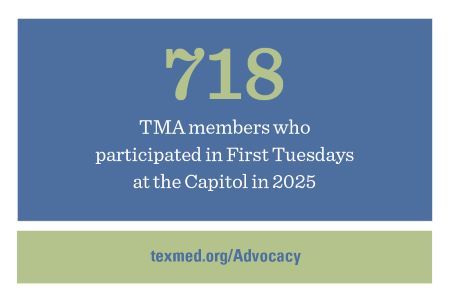
- Register for First Tuesdays at the Capitol: Join your colleagues in Austin the first Tuesday of each month in February, March, April, and May during a legislative session to meet with their legislators. For those who can’t make it, TMA instituted Monday night legislative briefing calls before each event with vital information to share with legislators at any time.
TMA advocacy over the years has produced precedent-setting state laws, Mr. Stewart says, such as medical liability reform, prior authorization exemption legislation, and surprise billing and prompt pay laws that lead the nation. At the federal level, the association has worked to mitigate Medicare payment cuts and push for enforcement of the No Surprises Act.
TMA staff also traverse the state to county medical societies to deliver educational presentations on the legislative process and outcomes – and on the association’s political action committee, TEXPAC, without which “we can’t identify, educate, and support candidates and then elected officials in a position to get legislation passed that helps us,” Dr. Widmer said.
“Every time you participate in TMA advocacy efforts, that goes toward protecting your practice.”
Last Updated On
June 30, 2026
Originally Published On
June 30, 2026
Phil West
Associate Editor
(512) 370-1394
phil.west[at]texmed[dot]org

Phil West is a writer and editor whose publications include the Los Angeles Times, Seattle Times, Austin American-Statesman, and San Antonio Express-News. He earned a BA in journalism from the University of Washington and an MFA from the University of Texas at Austin’s James A. Michener Center for Writers. He lives in Austin with his wife, children, and a trio of free-spirited dogs.
Amy Lynn Sorrel
Associate Vice President, Editorial Strategy & Programming
Division of Communications and Marketing
(512) 370-1384