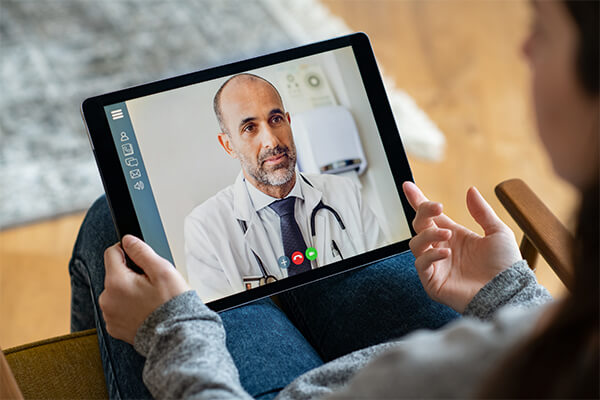
As state lawmakers weigh the use of telemedicine and virtual care models, the Texas Medical Association prioritizes payment parity, investment in affordable, accessible infrastructure, and continued work on information interoperability.
To guide its advocacy, TMA submitted written testimony from Thomas Kim, MD, arguing as much to the House Committee on Public Health, which has interim charges of evaluating telemedicine in Texas and its impact on access, cost, quality, and patient outcomes.
The committee, which met on June 4 at the Capitol, is also charged with modernizing health care technology in Texas.
TMA supports the use of telemedicine as a means to extend access to care to patients who face barriers like distance and has advocated for legislation to promote equal payment for those services with in-person services while keeping a mindful eye that virtual care is not seen as a substitute to conventional in-person visits.
“Whether 200 miles or two blocks from a physician, people can experience numerous complications impacting access to care. I routinely care for people from home or in their car without them losing a day’s pay or facing some other access barrier,” testified Dr. Kim, a member of TMA’s Council on Science and Public Health and consultant to TMA’s Committee on Health Information Technology and Augmented Intelligence.
The Austin psychiatrist told the committee the COVID-19 pandemic stress-tested telemedicine and proved its functionality, boosting its popularity. But post-pandemic waivers allowed full payment only for limited timeframes, leading to an unintended chilling effect due to long-term uncertainty.
“So given the impact on access and evidence of telehealth maturing, I ask: How can Texas be mindful of waiver extension uncertainty leading [some] individuals and institutions alike to withdraw from offering telehealth, leaving access challenges to persist?” Dr. Kim said.
Dr. Kim testified that telemedicine can positively impact health care costs, as physicians often use the tool to maintain wellness and avoid future illness. For example, Dr. Kim told the committee he’s used telemedicine technology to support a juvenile detention center in Louisiana for the last 20 years.
Others have proposed to reduce costs with lower payment rates for telemedicine compared to conventional care, but that would merely limit its availability in the future, he added.
“Candidly, I do not understand the logic of different payment rates [for services provided via telemedicine versus in person] other than to predict further reduction in telehealth availability,” he testified.
Since telemedicine allows physicians to intercede early before health crises cause patient harm, when it comes to measuring quality, Dr. Kim often cites “the difficulty of proving a negative.” Still, Dr. Kim says a growing body of data suggests telemedicine services are leading to more positive outcome trends, something he’s seen firsthand.
“Avoiding an emergency department visit, hospitalization, or worse can only be speculative until a large enough data set demonstrates a positive outcome trend,” he said. “Fortunately, this data set continues to grow, and I remain hopeful that the results will confirm my personal experience.”
As a member of the governor’s Broadband Development Council that oversaw the distribution of $3 billion in federal funds, Dr. Kim adds that affordable broadband access is critical to strengthening telemedicine services. So is interoperability, or the effective sharing of information across digital platforms, which helps telemedicine overcome distance, time constraints, and financial pressures.
“Being the right person at the right time with the right information is key to better health care,” Dr. Kim said.
Keep up with TMA’s testimony on the state advocacy webpage.