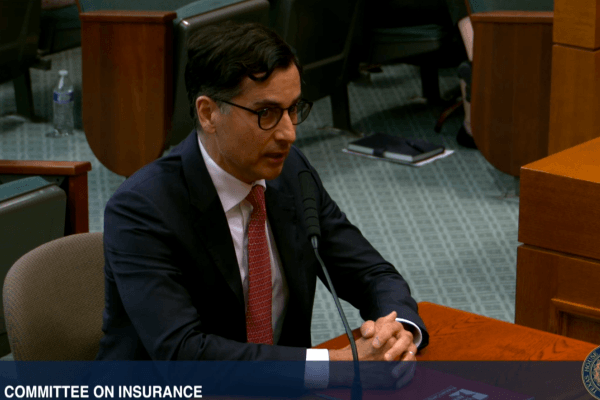
Looking ahead to the 2027 legislative session, the Texas House Committee on Insurance is taking a broad look at what drives health insurance costs for Texans – and testimony from the Texas Medical Association underscored systemic issues impacting patients’ access to care.
Before the legislature convenes in January, the House Committee on Insurance is charged with reviewing employer-sponsored health plans, small-business health options, and the impact of federal and state policies on health care coverage, access, and affordability.
“Texas physicians share the committee’s goal of making coverage more affordable,” said San Antonio radiologist Ezequiel “Zeke” Silva III, MD, testifying on behalf of TMA. “We see patients who delay care because of cost, who discover their network is inadequate, who abandon treatment because of administrative barriers, and who become sicker and more expensive to treat as a result.”
During the June 4 hearing, TMA shared its position that reducing these barriers through legislative reforms can improve both access and affordability.
As lawmakers evaluated ways to improve health coverage affordability, insurance representatives at the hearing blamed rising medical costs for premium increases, arguing that until reductions occur, premiums will remain high – and patients will continue to face a lack of affordable care.
But Dr. Silva emphasized to legislators that health care affordability encompasses more than just the cost of monthly insurance premiums.
“The key point is that premiums reflect the underlying cost of covered care. If we want to lower premiums, we have to look underneath the premium,” said Dr. Silva, a member of TMA’s Board of Trustees and past chair of the association’s Council on Legislation, addressing a committee room filled with health plan representatives.
He argued physicians regularly see treatment delayed by insurance-related barriers – such as high out-of-pocket costs, coverage restrictions, administrative hassles, consolidation, delayed payment, and shifting plan rules. These setbacks lead to harm and stress for patients, as well as expensive interventions that drive up costs.
Dr. Silva urged the committee to strengthen patient access to care while reducing unnecessary administrative obstacles. He asked lawmakers to consider policies that:
- Strengthen enforcement of prior authorization reforms, and treat reducing physician administrative burden as a cost-containment strategy;
- Increase transparency of pharmacy benefit manager practices to protect patients from aggressive cost-shifting tactics, such as copay accumulator programs, copay maximizer programs, and alternative funding programs;
- Protect meaningful coverage with clear consumer disclosures and preservation of important patient and physician protections;
- Improve transparency for patients about premiums, deductibles, networks, coverage rules, utilization management, prescription drug costs, and estimated out-of-pocket obligations, not just posted prices; and
- Continue to invest in better access to preventive care, primary care, behavioral health, maternal care, and chronic disease management to reduce avoidable downstream spending.
On the opposite end, Dr. Silva’s testimony called on lawmakers to oppose legislation that increases administrative burden on physicians or threatens a physician’s clinical decision-making.
“The core message of our testimony is simple: Texas can expand affordable coverage options without weakening the protections that promote competition and make coverage worth buying. Lower premiums on paper are not enough. Coverage must provide real access, timely care, and protection against costs patients cannot predict,” Dr. Silva said.
Follow TMA’s legislative testimony and related Texas Medicine Today coverage on the state advocacy webpage.
Alisa Pierce
Reporter, Division of Communications and Marketing
(512) 370-1469