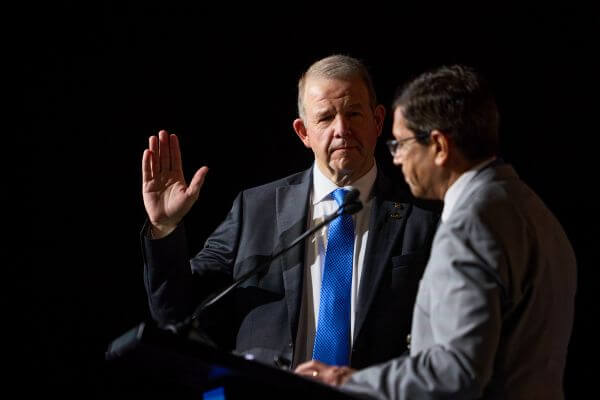
“Our health care system needs a rescue,” Bradford W. Holland, MD, declared at TexMed 2026 in Corpus Christi, rallying physicians via an eight-point plan at the center of his first speech as the Texas Medical Association’s newest president.
Praising TMA as a “flagship, best-practice leader … that truly does put patients first,” its 161st president pledged to lead it over the coming year “to fight for our patients, to reclaim medicine, and to reignite our passion to save our profession.”
Dr. Holland’s more than 20 years of medical practice, much of it independent, inform his stance against issues plaguing the current health care system.
“It is morphing into something that does not serve patients well,” the Waco otolaryngologist said, describing employer-based health care as an 80-year experiment that is failing. Asserting physicians must be the ones to improve health care for themselves and their patients, he laid out an eight-point plan that includes:
- Restoring physician-owned hospitals;
- Repealing Medicare self-referral restrictions under the federal Stark Law;
- Implementing site-neutral payments that ensure physicians receive the same payment regardless of where they care for patients, and tying Medicare physician payment updates to inflation;
- Revisiting the use of nonprofit tax status for health systems when they function like for-profit entities;
- Reforming Employee Retirement Income Security Act of 1974 (ERISA) insurance exemptions, for as he put it, those “loopholes allow insurance companies to deny care with limited oversight;”;
- Protecting physician judgment in the age of artificial intelligence;
- Supporting a collective voice for employed physicians; and
- Reclaiming the profession of medicine by rejecting the term “provider” as a substitute for physician.
That last point is particularly meaningful to Dr. Holland, seeing it as a key to physicians reclaiming medicine for themselves and their patients.
“We are physicians – practitioners of one of the oldest and most respected professions,” he said. “Ours is a calling that blends science and art, intellect and compassion, skill and human connection. There is a reason stories are told about what we do – because it is difficult, because it is meaningful, and because it matters.”
Dr. Holland shared he formed part of that perspective over nearly six years he spent battling stage IV colorectal cancer. He was initially diagnosed in 2004 at age 33.
“It gives you a different perspective on what we physicians do. But more importantly, it gives you a healthy and humbling perspective – because what we do is so important,” he said. “This made me deeply thankful for the physicians who got me through it, who were there with me, who treated me, and who saved my life.”
Let doctors be doctors
Dr. Holland takes the reins from Immediate Past President Jayesh “Jay” Shah, MD, who as he concluded his term, thanked physicians for their ongoing advocacy and commitment to their profession.
Dr. Shah began his sendoff speech to TMA’s House of Delegates with a simple question: How many physicians in the room were burdened by prior authorization and increasing documentation requirements?
Unsurprisingly, almost every hand in the packed TMA House went up, which is “exactly why” Dr. Shah said one year ago he began his presidency with his personal slogan: “Let doctors be doctors.”
“Today as I conclude my journey as your president, those four words mean more to me than they did a year ago,” the San Antonio internist and hyperbaric medicine specialist said. “After traveling across the state, after listening to hundreds of physicians, after hearing your stories, I know something with certainty: Those four words are not a slogan; they are a calling.”
That core message was highlighted by the Let Doctors Be Doctors podcast Dr. Shah started during his presidency, featuring real stories from Texas physicians about their journey into medicine, challenges they have confronted, and how they deal with burnout when it occurs.
Dr. Shah said both the podcast and his travels around Texas reinforced his long-held belief that health care challenges like prior authorization and increasing documentation requirements are not isolated frustrations – but instead systemic issues requiring sustained advocacy from Texas physicians.
On that note, he highlighted during his speech key advocacy efforts from TMA members during last year’s legislative session. For instance, physicians translated medicine’s concerns into action by opposing Senate Bill 268, which would have halted the Texas Medical Board’s ability to stop the unlicensed practice of medicine by health professionals licensed by another agency in Texas.
As Dr. Shah stepped down from his presidency, he left behind the message that progress in medicine depends not only on innovation and perseverance, but in physicians standing together to reshape the systems in which they practice.
“The physician you are today does not have to be the physician you are tomorrow. Burnout is not the end of your story. Reinvention is possible. Hope is possible. Community is possible.”
Phil West
Associate Editor
(512) 370-1394
phil.west[at]texmed[dot]org

Phil West is a writer and editor whose publications include the Los Angeles Times, Seattle Times, Austin American-Statesman, and San Antonio Express-News. He earned a BA in journalism from the University of Washington and an MFA from the University of Texas at Austin’s James A. Michener Center for Writers. He lives in Austin with his wife, children, and a trio of free-spirited dogs.
Alisa Pierce
Reporter, Division of Communications and Marketing
(512) 370-1469