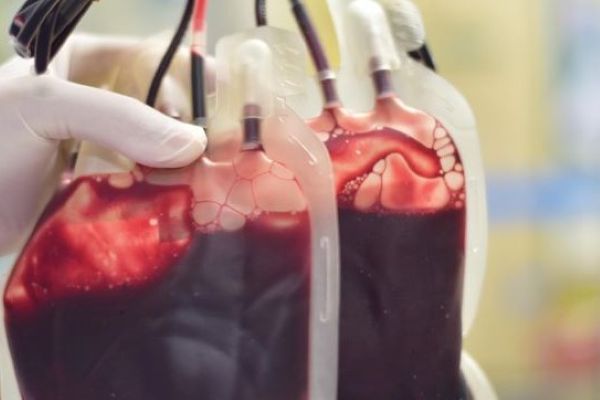
El Paso trauma surgeon Alan Tyroch, MD, couldn't predict the success of a $10-million state pilot program to deploy prehospital whole blood into the field. But so far, the results have been staggering: data show lives are being saved in emergencies across Texas.
A new Texas Department of State Health Services (DSHS) report shows since the program’s inception earlier this year, 516 of 523 patients (98.7%) who received whole blood from Texas EMS crews arrived at the hospital alive.
State legislators unveiled the landmark investment in prehospital whole blood during the 2025 session. The Texas EMS Alliance recommended the legislature appropriate $4 million for the pilot – but the legislature ended up appropriating $10 million, enough to get prehospital whole blood into an additional 101 counties. In total, 151 Texas counties with EMS providers were funded to give prehospital whole blood in the field.
Other states are using prehospital whole blood, too. But with cooperation between providers, blood centers, hospitals, and trauma physicians, “Texas is clearly leading the way,” Dr. Tyroch said.
“It was a pilot program, and we had to demonstrate success or not. I think we have,” said Dr. Tyroch, chair of surgery at Texas Tech University Health Sciences Center El Paso. “I’m positive that it will be sustainable.”
DSHS finalized contracts with 21 of the state’s 22 Regional Advisory Councils (RACs) by April. Within months, the number of emergency providers carrying prehospital whole blood expanded from 103 to 261.
Prehospital whole blood previously reached 15.7 million Texans across 50 counties. As of September, it reached 27.2 million Texans – 59.4% of the state, according to the DSHS report.
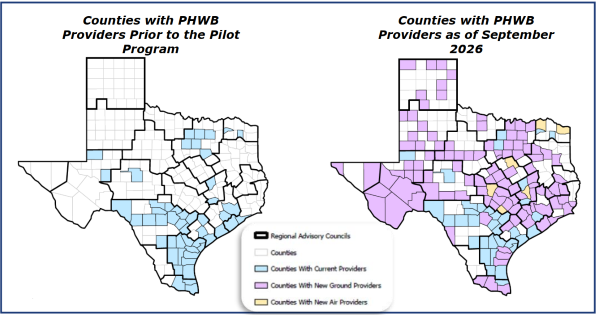
“Seeing that map means every effort paid off, for sure,” said Carlos Palacio, MD, a member of the Texas Medical Association’s Committee on Emergency Services and Trauma. “Hopefully the legislators that trusted us with this will be quite excited.”
Dr. Palacio, chair of Trauma Regional Advisory Council (TRAC-V), is personally excited about the patient success stories, several of which DSHS cited in its report:
- Fort Worth Fire Department EMS responded to a patient who had been shot several times in the leg and was in cardiac arrest on arrival. Responders restored the pulse, administered whole blood during transport, and the patient left the hospital with full function.
- South Texas emergency personnel treated a patient with a stab wound and uncontrollable bleeding. After a transfusion, the patient survived and was discharged a few days later.
- A West Texas trauma surgeon treated a patient who sustained a life-threatening injury in a car accident. The patient received prehospital whole blood in the field before transport and survived after specialized trauma care.
- A South-Central Texas emergency physician treated a patient injured in a car crash. Prehospital whole blood administered during resuscitation prevented a life-threatening hemorrhage.
As part of the pilot program, each RAC was required to support blood collection. As of Sept. 1, RACs had sponsored 21 community blood drives.
The report also named remaining obstacles. For instance, a mobile cooler that keeps blood cold during transport – central to the pilot – now takes 120 days to purchase due to manufacturing challenges. This shortage has limited how many EMS providers can carry whole blood. RACs also still need administrative support from hospitals and clinical discretion from physicians so that units of whole blood or plasma get used before they expire.
Eric Epley, chair of the Governor’s EMS and Trauma Advisory Council Prehospital Whole Blood Task Force, appreciates Texas physicians learning about whole blood and incorporating it into their practice.
“This straightforward step of having hospitals use it for their emergency resuscitation for emergency release blood would be a really big step,” Mr. Epley said.
Dr. Tyroch has seen whole blood use skyrocket at University Medical Center of El Paso in recent years. In June 2020, the hospital received only one unit of whole blood per week. Now, it’s up to 20 per week. In 2025, the medical center used 846 units, and from January to July 2026 it used 677 units and counting, Dr. Tyroch says.
Mr. Epley says if more hospitals transitioned to using whole blood – a practice that dates to World Wars I and II – the volume of blood in the field could quadruple.
If every hospital in the state pitched in, “that would be magnificent and better for the patients,” Mr. Epley said.
Gain valuable insights into the regional blood rotation systems, equipment standards, and the state-level pilot programs driving broader implementation through TMA's whole blood CME course, available free to association members.