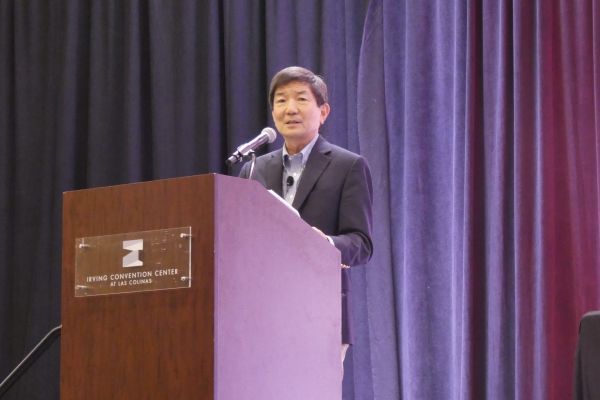
Few physicians know more about medical misinformation than Philip Huang, MD. Drawing on his experience as director and health authority for the Dallas County Health and Human Services Department, Dr. Huang shared clear and practical guidance for communicating the truth at the Texas Medical Association’s Leadership Summit on Sept. 19.
Dr. Huang played a pivotal role in leading North Texas through the COVID-19 pandemic and was recently honored by the American Medical Association for his work to strengthen the public health infrastructure, address chronic disease and HIV, and modernize Dallas County’s public health data systems.
Though misinformation notably spiked during the pandemic, Dr. Huang says the U.S. Surgeon General and the World Health Organization have since organized helpful studies to address the fallout and prevent bad actors from taking hold.
“Fortunately, there is some evidence base now on how we combat misinformation,” he told attendees during his talk, at the invitation of TMA’s Women’s Physician Section and sponsored by the TMA Insurance Trust.
Providing advance warnings, debunking myths through corrective messaging, and recognizing manipulation are all pivotal ways physicians can remain trusted sources of information.
“When you combine communication, community engagement, and access to service assessments, studies show that [combination] is the most effective,” Dr. Huang stressed.
He added that physicians can build trust before any emergency by being active in their communities:
- Show up and maintain a visible presence in the community.
- Track questions patients and the public are asking in the clinic or via social media.
- Use plain language and acknowledge when there’s uncertainty on either side of a question.
“Explain what is known, what remains [unknown], and so on,” he added. “Here’s why the guidance can change, and then, what's the action, the clear step that people can take now. Give them a source, a web page or your office or phone line, something that stays current with that information so that they can follow up with that.”
The first 24 hours of any emergency are critical for messaging, Dr. Huang says, adding it’s imperative that physicians lead with accurate information. That includes publishing the correct information and repeating or distributing it everywhere. The information void is where wild speculation can quickly take hold.
“Effective correction starts with the truth,” Dr. Huang said. “Avoid placing the false claim in the headline or the first sentence. Although there's less emphasis on that, we still need to address it. We're going to start with the accurate information first.”
Leaning on his vast experience in public service, Dr. Huang also provided a timeline of what medical authorities can do in the early hours of a false claim to prevent its spread:
- 0-2 hours: Confirm facts, identify the authority making decisions around the topic at hand, and name what remains unknown.
- 2-6 hours: Publish a holding statement, update website and phone bank.
- 6-12 hours: Brief clinicians, partners, address the highest-risk narrative.
- 12-24 hours: Review questions and analytics, correct gaps, and schedule updates.
Physicians looking to build trust with patients can listen to A Better Question, a new podcast from TMA featuring Thomas Kim, MD, a member of TMA’s Council on Science and Public Health. Episodes are available on TMA’s website, Apple Podcasts, and Spotify.