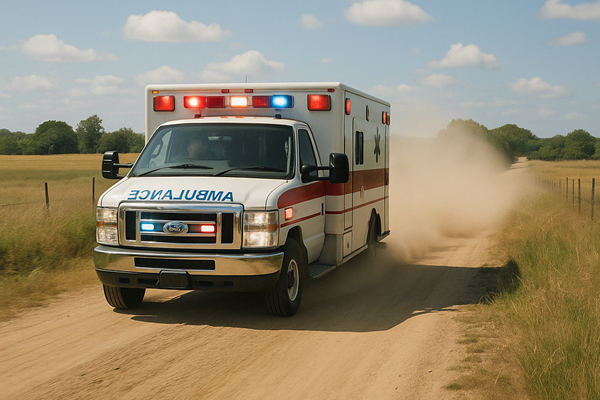
A rural ambulance grant fund approved by the Texas Legislature in 2025 has distributed nearly $50 million to 134 Texas counties as of July 1, 2026, addressing a major rural health concern for physicians across the state.
According to the Texas Comptroller of Public Accounts’ website, each of the 134 counties has received either $350,000 or $500,000 through the fund, which was authorized by House Bill 3000. The bipartisan bill, supported by the Texas Medical Association, was approved during the 2025 legislative session to minimize “ambulance deserts” across the state, delivering prehospital care to rural patients and getting them to the hospital faster.
The comptroller’s office notes that HB 3000 allows for additional funds to be distributed through fiscal year 2027.
Texas Medicine Today reported earlier that counties receiving grants have up to five years to spend the money earmarked for ambulance purchases, and they are free to choose their vendors.
Robert Emmick, MD, a member of TMA’s Committee on EMS and Trauma, welcomed the grant program as a step toward “a single standard of care across the state.”
“Often, rural EMS systems are mainly manned by volunteers and work on a shoestring budget,” Dr. Emmick said. “This state infusion of money is a significant benefit to these services … this will go a long way in providing service throughout rural Texas.”
The funds will allow each county receiving a grant to put one or more ambulances into circulation, including in counties where a mechanical issue with its lone ambulance could leave residents with reduced service or none at all.
“They rack up numerous miles and they get old in a hurry, and they need servicing and eventually replacements sooner than urban units just because of the distances out here,” said Adrian Billings, MD, an Alpine family physician and a member of TMA’s Council on Legislation.
Dr. Billings adds that the counties receiving $500,000 – earmarked for those with populations under 10,000 – especially benefit, since they collect less tax revenue than more populated counties.
“The extra funds really make a difference,” he notes.
Brewster County – the state’s largest county by area, stretching across nearly 6,200 square miles – faced an EMS cliff when applying for the grant this January.
Emergent Air, which has provided EMS for north Brewster County since May 2022, announced it would not renew its ground-ambulance contract beyond its May 2026 expiration. The agreement was extended until the county’s November election, which would create an emergency services district in the northern half of the county that includes its two largest towns. That district would complement an existing one in the southern half of the county, which includes Big Bend National Park and the town of Terlingua.
In the meantime, County Judge Greg Henington will use Brewster County’ $500,000 grant to purchase two Type III ambulances, which use a van chassis rather than the truck chassis used by more expensive Type I ambulances.
“The money’s in the bank cooking interest right now,” Judge Henington said. “I’ll probably spend the summer nitpicking all the vendors, and I’ll put the orders in.”
He adds that after applying for the grant, Brewster County acquired an ambulance from Glasscock County, which will be stationed in the town of Marathon, 30 miles east of Alpine.
“It’s nice to have another unit, and to place it in Marathon, which has not had any ambulances and has had to rely on the ambulance from Alpine arriving,” said Dr. Billings, who has served on the task force to address Brewster County’s EMS concerns. “That unit is definitely going to save lives by being placed there.”
Dr. Billings sees the addition of that ambulance, plus the two being purchased with grant funds, as examples of how essential ambulances are to rural health.
“Without those ambulances, people can get sicker or die, so a community really relies on ambulances to provide that pre-hospital service,” he added.
Phil West
Associate Editor
(512) 370-1394
phil.west[at]texmed[dot]org

Phil West is a writer and editor whose publications include the Los Angeles Times, Seattle Times, Austin American-Statesman, and San Antonio Express-News. He earned a BA in journalism from the University of Washington and an MFA from the University of Texas at Austin’s James A. Michener Center for Writers. He lives in Austin with his wife, children, and a trio of free-spirited dogs.