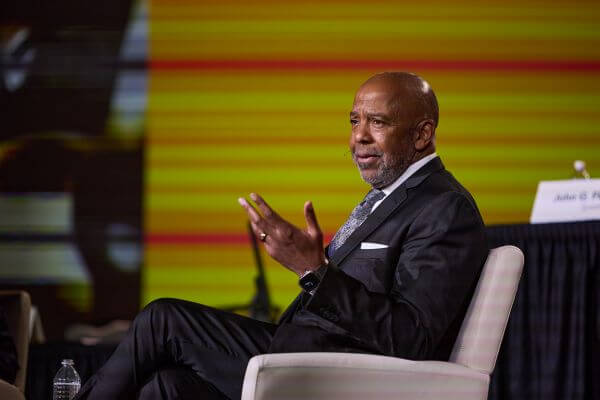
Highlighted by a captivating conversation with a NASA astronaut-physician, TexMed 2026 was a success in its first visit to the Texas coast since 1993.
Bernard Harris Jr., MD, enthralled the audience of more than 700 physician, resident and student members who ventured to Corpus Christi – including 192 first-timers – who also had their own chance to chart a course through Texas Medical Association’s annual policymaking conference, robust Expo Hall, and poster session. Attendees witnessed the installation of new presidents, congratulated a longtime member receiving TMA’s highest honor, and regaled the graduating class of the association’s Leadership College.
Opportunities for physician camaraderie, socialization, and professional networking have kept one member coming to TexMed for 30 years.
“[TexMed] is just impossible to replace in terms of being able to connect with folks that I knew when I started coming,” Lisa Nash, DO, said. “My colleagues across the state are doing the same things I’m doing, having the same issues I’m having, and solving the same problems I’m trying to solve.”
In helping to launch the conference, Dr. Harris – NASA astronaut and the first African American to walk in space – recounted his improbable arc from boyhood in the Navajo Nation to the U.S. Astronaut Hall of Fame and laid out a vision for the future of medicine. TMA Immediate Past President Jayesh “Jay” Shah, MD, guided the fireside-style conversation.
Dr. Harris, a 40-year TMA member inducted into the Hall of Fame in June 2025, said his journey began under the desert skies of the Four Corners.
“It was out there amongst those deserts and the Grand Canyon that I was inspired by looking at the stars at night,” the Houston internal medicine physician recalled, adding that President John F. Kennedy’s moon challenge and reruns of Star Trek convinced him medicine was his ticket to orbit.
The plan worked. After earning his medical degree at Texas Tech University Health Sciences Center and completing residency at the Mayo Clinic, Dr. Harris joined NASA’s Ames Research Center as an endocrinology fellow studying bone loss in microgravity. In 1990, he was one of 23 candidates selected from more than 6,000 applicants to the space program. He logged more than 438 hours in space across two shuttle missions and, in 1995, became the first Black American to perform a spacewalk.
For his physician audience, Dr. Harris explained how once in orbit, microgravity reroutes fluid toward the head, shrinks blood volume by roughly a fifth, and leaves about 30% of astronauts with visual-field changes from flattening of the globe of the eye.
Studying these changes, as well as the innovation of technology required for successful space travel, has a downwind boon on medical care, he argues.
“The future of medicine is going to rely on the future of space,” Dr. Harris said. Pacemakers, MRI imaging, and telemedicine all grew out of NASA research, he noted – and his company, Vesalius Ventures, was founded on that bet 22 years ago.
Feeling like “a proud pop” about the recent Artemis mission, Dr. Harris is surer than ever that humans will soon be able to expand to bases on the moon, which would ramp up other breakthroughs.
As far as developments earth-side, Dr. Harris sees similar potential in artificial intelligence (AI).
“If we don’t embrace it, it’s going to overtake us,” he said, while urging physicians to continue to supply the clinical data that keeps AI honest.
Through his Harris Foundation, which champions education, health, and wealth for underserved students, Dr. Harris continues to point the next generation upward.
“Find the profession,” he said, answering a question from Maximo Alvarez, a student at The University of Texas Rio Grande Valley School of Medicine, his interest piqued in an astronaut’s path. “Then we can find a place for you.”
After the speech, conferencegoers queued up to snap selfies with Dr. Harris and further discuss his experiences in space and how the Artemis missions will play out in the future.
Attendees also got the chance to learn about other technological developments at the brand-new Tech Village, an interactive space housed in the Expo Hall. The hub gave members hands-on access to emerging tools via interactive digital kiosks, the ability to connect with industry experts, and coffee Tech Talks presented by the TMA’s Committee Health Information Technology and Augmented Intelligence.
Other social and networking events included a mixer celebrating the 50th anniversary of TMA’s Medical Student Section and Resident and Fellow Section at the Texas State Aquarium, with sharks and other sea life joining students, and a send-off lunch highlighted by a breakdancing astronaut, a nod to the locale of next year’s conference, Houston.
Don’t miss TMA’s upcoming in-person meetings, including the Leadership Summit happening in September.