Last year, Denison gynecologist J. Timothy Parker, MD, prescribed a medication to treat his patient’s endometriosis, a chronic condition that causes severe menstrual pain. A few months later, the patient called his office in tears.
“I’m in pain,” she told Dr. Parker. “Where’s my medication?”
It was stuck in administrative processes that had begun weeks earlier, when the insurer asked for additional information. But even after Dr. Parker provided that information and participated in a peer-to-peer review with an internal medicine physician representing the payer, not another obstetrician-gynecologist, the payer denied the prescription. Dr. Parker’s patient waited more than two months for treatment as he appealed.
The episode, he says, was emblematic of a system that often turns a straightforward clinical decision into a prolonged administrative battle – one that takes him away from patients confused and in pain.
“It’s just so difficult. Insurers frequently make coverage decisions that are at odds with what physicians believe is best for their patients,” the former vice chair of the Texas Medical Association’s Council on Legislation (COL) said.
For years, physicians have heard the same promise from health plans: prior authorization is becoming easier, faster, and more transparent. But the reality remains more complicated. The American Medical Association’s 2025 prior authorization physician survey found insurers’ prior auth policies limit patient access to care, exacerbate physician burnout, and delay necessary treatments – sometimes leading to serious adverse events, including hospitalization, disability, or even death. Practices complete on average 40 prior authorizations per physician, per week.
Physicians and their patients encounter different requirements depending on the type of health insurance involved. State-regulated commercial health plans are subject to Texas laws, including the state’s “gold card” law. Government payers operate under different rules, and many employer-sponsored health plans are governed by federal ERISA law.
That regulatory framework means prior auth reform must happen on multiple fronts. New federal requirements are taking effect in 2026 and 2027; health plans are again highlighting voluntary reforms they say will further reduce administrative burden; and Texas has continued its efforts to strengthen its gold card system, designed to exempt physicians with consistently high approval rates from certain prior auth requirements. Physicians interviewed for this article remain cautiously optimistic on all three fronts.
“I want to be positive, but I know the history of insurance companies,” Dr. Parker said. “I’m afraid that no matter what changes we make, they will find a way around it.”
The federal government has been working for years to make prior auth less burdensome – to mixed outcomes, physicians contend.
In 2022, the Centers for Medicare & Medicaid Services (CMS) proposed a rule aiming to modernize the prior auth process, streamline requests, and exchange health care data more easily. The rule was later finalized in January 2024, and most components of the rule went into effect in 2026.
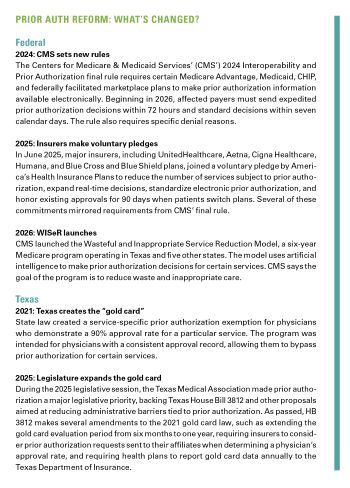
Under the rule, federally funded programs including Medicare Advantage plans, Medicaid managed care organizations (MCOs), and CHIP MCOs must respond to standard prior auth requests within seven calendar days and expedited requests within 72 hours, while providing specific denial reasons and publicly reporting certain prior auth metrics, including approval and denial rates, on their websites. These payers are also required to implement protocols that allow physicians to submit prior auth requests and receive decisions electronically starting Jan. 1, 2027.
A few months after the final rule was issued, CMS announced another piece: voluntary commitments from the insurance industry. In June 2025, more than 60 health insurers signed a pledge by the national trade association for the health insurance industry, America’s Health Insurance Plans, to “streamline, simplify, and reduce prior authorization” by reducing the number of services requiring prior auth, increasing transparency and communication around decisions, and implementing real-time responses to reduce delays, among other updates.
The pledge largely echoed the federal push to streamline prior auth, with some insurer commitments overlapping with then-upcoming rule requirements.
Houston family medicine physician Troy Fiesinger, MD, says some of the federal changes have provided some relief – at least on the utilization side of medicine. Dr. Fiesinger not only deals with prior authorization as a practicing physician; he also oversees the process as the associate medical director of utilization for his practice.
The member of TMA’s Council on Socioeconomics says the mandated seven-day turnaround for standard prior auth requests has noticeably improved his utilization-management team’s administrative workflow. But as a physician, he hasn’t experienced much change in his day-to-day clinical work.
One reason, he says, is that some commercial payers have yet to comply with the rule’s requirement – or their own pledges – when applicable to improve their electronic communication systems. Some insurers, he says, are still faxing prior auth denials, further delaying the process and, ultimately, patient care.
Even as the Jan. 1, 2027, federal deadline approaches, he, along with most Texas physicians, isn’t convinced payers will implement changes significant enough to improve patients’ and physicians’ experiences. Per the AMA’s 2025 prior auth physician survey, only 33% of physicians believe it likely that insurers’ commitments will meaningfully improve patient care.
“What I deal with most is medications not getting approved. And when something doesn’t get approved, it’s frustrating … for you and the patient,” Dr. Fiesinger told Texas Medicine. “Here’s my soapbox: the process of transmitting records to health plans could be a lot more efficient. There’s got to be a better way to make information flow.”
That’s where the federal push toward electronic prior auth could make a meaningful difference, Dr. Fiesinger says. But because the electronic infrastructure necessary to implement those changes has yet to be built, physicians are still waiting to see whether the promised efficiencies will materialize.
CMS’ Wasteful and Inappropriate Service Reduction (WISeR) Model offers an early – and narrow – opportunity to see how a more technology-driven approach to prior auth might work in practice. But it is still too early to know what results it will deliver, says San Antonio radiologist Ezequiel “Zeke” Silva III, MD.
Launched in 2026 in Texas and five other states, WISeR uses artificial intelligence (AI) and other technologies to expedite the utilization review process, primarily prior auth, for a select group of Medicare services. The initiative aims “to expedite and improve the review process for a pre-selected set of services that are vulnerable to fraud, waste, and abuse,” according to CMS.
WISeR applies only to traditional Medicare; Medicare Advantage is not affected. CMS says the six-year program is intended to identify services that may be wasteful or inappropriate while allowing appropriate care to move through the system more efficiently.
The program also includes its own version of gold card provisions, much like those under Texas’ gold card law passed in 2021. Physicians who demonstrate a history of high approval rates can qualify for an exemption from prior auth for certain WISeR services, a provision that could address one of physicians’ chief complaints: that they’re repeatedly required to justify care that has already been consistently approved for their other patients.
But WISeR is still new, and there are not yet meaningful data on how the program is affecting physicians or patients in Texas. That uncertainty is part of why last year, TMA and others across organized medicine urged CMS to pause WISeR’s implementation pending additional stakeholder input, more thorough analysis, and clearer guidelines for physicians and patients. Then-TMA President Jayesh “Jay” Shah, MD, warned WISeR could create “unanticipated and substantial administrative burden” for physician practices.
Dr. Silva warns using AI in utilization review could inadvertently give the technology the same practical authority over medical decisions as physicians – particularly if insurers rely on automated systems to provide recommendations on whether a service should be denied.
“We have to be very careful, because when you talk about prior authorization, one could easily argue that it is medical decision making,” the member of TMA’s Board of Trustees said. “Medical decision making requires a licensed physician. Physicians are open-minded about AI, but we worry about a lack of guardrails or appropriate oversight that could potentially be detrimental to patients’ safety.”
“If a physician prescribes a medication and the AI algorithm incorrectly recommends or suggests denying it, the consequences for patients are very real,” he added.
CMS announced last year that Cohere Health would serve as the technology vendor overseeing WISeR reviews in Texas. Since then, TMA has remained in close communication with Cohere, seeking information and feedback that can help physicians navigate the new process.
Dr. Fiesinger sees potential for technology to identify straightforward cases that clearly meet established criteria, allowing those requests to be approved without requiring a physician to spend time reviewing them. But he says complicated cases and any denial of care require human judgment. Clinical guidelines cannot account for every circumstance surrounding an individual patient.
“Denial should always be reviewed by a human being. There are times when the right thing to do is say yes, even if the guidelines say no, because the context is this is the right thing for the patient,” he said.
Texas has been wrestling with that challenge for years. The state’s gold card law, originally passed in 2021, allows a physician to qualify for an exemption from prior auth for a particular health care service if the physician submits at least five requests for that service during a one-year evaluation period (previously six months) and has 90% of those requests approved.
The idea was straightforward: If an insurer has repeatedly determined that a physician’s requests meet its criteria, the physician should not have to seek approval every time.
But Dr. Silva, who worked with lawmakers to achieve the reform as a then-member of TMA’s COL, says the relief physicians expected from the law, as implemented by the Texas Department of Insurance (TDI), has been limited. In testimony provided in 2024, TDI reiterated that it only regulates around 18% of the state’s health insurance market (i.e., the state-regulated plans). Considering the number of physicians who submitted the same service frequently enough to the same state-regulated insurer or HMO to have at least five attempts in the last six months (before HB 3812 passed in 2025), TDI noted the 2021 gold card law ended up positively affecting only 3% of Texas physicians.
“The 2021 gold card law has fallen way short of its promise,” Dr. Silva said.
Dr. Parker says his experience with the system has also left him frustrated. At one legislative meeting during his time as vice chair of TMA’s COL, he asked everyone in the room who had a gold card to raise their hands – and no one did.
“I don’t know anybody who has one,” he said.
That experience shaped TMA’s work during the 2025 legislative session. The association supported legislation refining Texas’ gold card law by extending the physician evaluation period from six months to one year, codifying the five-service minimum threshold, expanding the data to be used in an exemption evaluation, and other initiatives.
TMA also pushed back against legislation that threatened to weaken Texas’ existing protections. House Bills 139 and 4012 attempted to create employer-choice health plans exempt from almost all pro-patient and pro-physician insurance laws in Texas, including the gold card law, and to impose criminal penalties and a whistleblower cause of action against physicians in commercial billing disputes. Because of advocacy from TMA and Texas physicians, the bills did not pass in 2025, but TMA expects the issues to return in future sessions.
For TMA, the implementation issues associated with the gold card system have also prompted additional advocacy efforts related to prior auth reform. Rather than determining which individual physicians deserve an exemption, Dallas OB-gyn Deborah Fuller, MD, says TMA is considering potential legislative proposals that would shift the focus to the service itself.
Under the existing gold card model, a physician must demonstrate a history of getting requests approved. Dr. Fuller, a member of TMA’s COL, says the association is exploring potential legislation that would require health plans to demonstrate why a service needs prior auth in the first place – and to eliminate prior auth altogether for services that insurers approve 90% of the time.
Dr. Fuller has treated patients whose care was delayed by prior auth, including one whose medically necessary MRI was denied twice. It ultimately took a peer-to-peer review and roughly six weeks to obtain approval. The MRI then revealed a devastating diagnosis: pancreatic cancer.
Dr. Fuller says the family will never know whether the delay changed the patient’s prognosis, but the experience illustrated why the administrative process can be so troubling. Rather than relying on a gold card that many physicians may never qualify for, Dr. Fuller said TMA is considering whether to “attack the redundancy of prior auth at the service level, not at the physician.”
“Have we seen the gold card make dramatic changes? No, I don’t believe we have,” she said. “But it highlighted the need for prior authorization reform, and we’re not done trying to improve the prior auth process.”
Texas is continuing to refine its approach each legislative session, with TMA looking to next year’s session to continue the fight against AI-driven claim denials and legislation that could weaken gold card provisions. TMA also plans to support legislation that could exempt more services from prior authorization, including treatment for certain chronic conditions.
“A lot of the promises from insurers about reducing services subject to prior auth seem to be because states have started to crack down on prior auth,” TMA lobbyist Ben Wright said.
Physicians have heard promises before. For Dr. Parker, that history makes optimism difficult.
“We’ve made great strides,” he said. “We still have ways to go.”