Network adequacy is a basic concept, but its consequences can turn something that ought to be simple – a patient seeing a physician – into something much more complex.
For physicians, being included in or excluded from a health plan’s network affects the payer mix they rely on for their practice to stay viable, how many established patients can keep seeing them at in-network rates, and their ability to bring in new patients.
For patients, whether a physician is in or out of network affects basic logistics: how much to budget for an office visit, how long to wait to get an appointment, how far to drive, and how much time to take off work. Network status can also affect a patient’s continuity of care and ongoing relationship with a trusted physician, as well as their out-of-pocket expenses since cost-sharing responsibilities imposed by health plans are often higher for out-of-network care if there is an out-of-network benefit.
Those stakes are rising. Three years after the Texas Medical Association helped pass House Bill 3359 – the state’s strongest PPO and EPO network adequacy law to date – the Texas Department of Insurance (TDI), in response to a lawsuit filed by the Texas Association of Health Plans (TAHP), has proposed new rules that TMA warns would weaken the law’s protections. With the 2027 Texas legislative session approaching and physicians statewide reporting narrower networks and patients traveling farther, TMA is pushing back on multiple fronts.
TMA President Bradford W. Holland, MD, an otolaryngologist who sees patients in Coryell Health’s Waco and Gatesville locations, has watched the lengths to which patients sometimes must go to stay in-network.
“It really challenges rural patients, in terms of how far they have to travel to the closest regional center, but the closest regional center may not be in-network even then, so it can double or triple the distance to travel,” he said.
But patients in non-rural settings suffer too. Dr. Holland marvels that he, in Waco, was the closest physician in-network with an Affordable Care Act exchange plan to a patient unable to find an in-network physician anywhere in the Dallas-Fort Worth metroplex and drove nearly three hours one way for medical care.
“So, it can happen in very perverse ways, in ways that you would not expect whatsoever,” he added.
Michelle Berger, MD, chair of the Texas Delegation to the American Medical Association and a retired Austin ophthalmologist, adds patients are often surprised by how few in-network options they have. One health plan she encountered, for example, had its closest pediatric orthopedists for Austin patients based in San Antonio – an often traffic-clogged 80-mile drive south.
“The problem is that patients don’t understand when they purchase insurance, or they get insurance from their employer, what the limitations are,” she said. Those limitations may include not having enough doctors in network for a specific specialty to be seen in a timely fashion, or a physician who a patient has been seeing for many years suddenly being pulled from that patient’s health plan network.
Dr. Berger describes convenient physician access as the ideal for network adequacy but characterizes health plans as “playing games” – pressuring physician practices to accept unreasonably low payments to be included in their networks, or excluding them altogether, which makes care more expensive, travel-intensive, and time-consuming for patients.
“Patients are not happy with you. They don’t blame the insurance company; they blame the physicians,” Dr. Berger said. “They’re saying, ‘Why can’t I see a doctor here in Austin?’ … You get patients not getting well cared for, not getting timely care, [which doesn’t] help you as a physician provide good care.”
In 2023, Texas legislators strengthened network adequacy standards by passing House Bill 3359, which in part requires state-regulated PPO and EPO health plans to demonstrate they made good-faith efforts to contract with physicians and others in order to build an adequate network.
Both Drs. Berger and Holland agree that while HB 3359 improved network adequacy standards for those plans, enforcement by TDI has remained a concern.
Some of that concern stems from TDI’s implementation of statutory provisions that allow TDI to grant health plans a waiver from network adequacy standards if TDI determines there is “good cause” to do so considering the plan’s “good faith efforts” to contract with uncontracted physicians and others that would help bring the plan into compliance.
Additionally, if a health plan requests a waiver for the same network adequacy standard in the same county for the third year in a row, it must demonstrate it made “multiple good faith attempts” to contract with uncontracted physicians and others that would help bring the plan into compliance, in addition to TDI’s determination of whether “good cause” is shown.
As of this writing, a lawsuit between TDI and TAHP, a trade association for insurers doing business in Texas, has put those good-faith-effort checks on hold for PPO and EPO plan networks submitted to TDI in 2026 and set for consumer use in 2027. It has also kept TDI from issuing any findings of failure to demonstrate “multiple good faith attempts” to bring plans into compliance.
The dispute prompted TDI to craft new proposed rules. TMA scrutinized those in a June comment letter as running counter to the law’s intent and threatening access to care, patient choice, and physician payment.
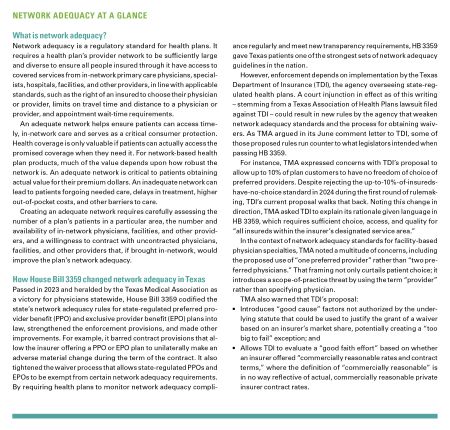
In particular, a proposed rule would allow TDI to evaluate a good-faith effort based on “whether an insurer offered to contract a commercially reasonable rate” where the definition of “commercially reasonable” is in no way reflective of actual, commercially reasonable private insurer contract rates. This would let health plans characterize their offer of unreasonably low rates, possibly even ones based on Medicaid or CHIP rates, as “commercially reasonable.”
Those payment floors, TMA warns, would create negative downstream effects for both physicians and patients. Physicians may face reduced payment, shaving already thin margins and creating challenges to practice viability and patient access to care. And, alternatively, if network participation declines, patients may have fewer options for in-network care and potentially face more out-of-pocket expenses.
In addition to tracking the rulemaking, TMA is prepared to play defense in the Texas Legislature’s upcoming 2027 session against bills that could weaken network adequacy standards, and against measures that would allow “skinny” health plans to leave subscribers insufficiently covered in the name of health care affordability.
“It used to be that insurance companies wanted, from a marketing standpoint, to have large networks with everybody in them. That’s completely changed, and I don’t know if physicians are always aware of that,” Dr. Holland said. Insurers want narrow networks now because that allows them to further control utilization and costs, he adds.
Zeke Silva, MD, a member of TMA’s Board of Trustees and a San Antonio interventional radiologist, says that physicians generally like to be in networks to broaden their patient pools and provide care.
“We generally want to be in the network because it gives us access to those patients who might not otherwise reach us,” he said. “The trade-off is, in exchange for access to that patient population, physicians agree to a contracted rate that may be lower than prevailing market rates. That can still make sense because it provides patient volume and helps sustain the practice. So, network adequacy isn’t just about patient access; it’s also about practice viability.”
The negotiation process between practices and insurers depends on numerous factors, Dr. Silva adds, such as the size of the practice, where it is located, and how many offices and clinics its patients can access.
“We would hope it’s not just the size of a practice that matters, but also its quality and the value it brings to patients. Those should be the reasons a health plan wants a practice in its network,” he said. In particular, he hopes that independent small practices don’t feel pressured to join larger groups or sell their practices to corporate entities to improve their bargaining position with insurers.
Negotiations also depend on how many types of plans an insurer offers.
“For some plan products, physicians might be able to negotiate a higher payment rate in exchange for committing to greater access for patients,” Dr. Silva said.
For physicians to get the full benefit of being in-network, health plans have to keep beneficiary-facing directories current. Dr. Berger says health plans could be more consistent in following the existing laws that require those updates, and TDI could be more vigilant in making sure they do.
“I retired in May of 2024, and I’m still getting requests as if my practice is open,” she said – indicating to her she’s still being listed as an in-network option even though she no longer is.
Dr. Berger notes the importance of physicians raising concerns about network inadequacy when they see it, whether through TMA’s Physician Payment Resource Center, through TMA’s legislative advocates, or directly to TDI.
“I bet that … public exposure of [poor compliance] would probably be the best thing we could do and the most cost-effective thing,” she suggested.
While more legislation may eventually be needed to steer health plans toward better compliance – without making it too onerous for insurers to do business in Texas – Dr. Berger would like to see TDI make fuller use of the tools it already has.
While Dr. Holland fears what insurers might do if regulatory guardrails are loosened, he also sees an opportunity to work with TDI not just on improving network adequacy enforcement – crediting the relationship TMA has fostered with the agency – but on bigger, more holistic reform.
“It’s going to take a [heavy lift] ... and also the legislature and an appetite to really have health insurance reform,” he said. “I think the public is finally getting fed up. The legislators are getting fed up.”
Phil West
Associate Editor
(512) 370-1394
phil.west[at]texmed[dot]org

Phil West is a writer and editor whose publications include the Los Angeles Times, Seattle Times, Austin American-Statesman, and San Antonio Express-News. He earned a BA in journalism from the University of Washington and an MFA from the University of Texas at Austin’s James A. Michener Center for Writers. He lives in Austin with his wife, children, and a trio of free-spirited dogs.