
Why does Medicare Advantage appeal to patients? Troy Fiesinger, MD, associate medical director for utilization management at Kelsey-Seybold Clinic in Houston and a member of the Texas Medical Association’s Council on Socioeconomics, boiled it down to one phrase: “There’s a patient benefit and a perceived patient benefit.”
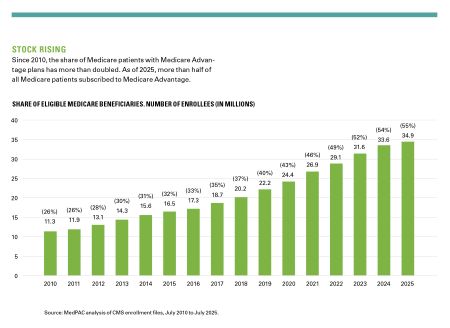
That balance – between what patients get and what they think they get – increasingly shapes how Texas physicians practice medicine. Medicare Advantage now covers 55% of Medicare beneficiaries nationally, up from 37% in 2018, according to the Medicare Payment Advisory Commission’s (MedPAC’s) March 2026 report. Texas mirrors that national rate, but in Starr County and other border communities, enrollment tops 75%.
The shift is remaking the physician payer mix, the terms on which physicians get paid, and – through prior authorization and narrow networks – growing risk-adjustment and documentation demands.
Medicare Advantage – provided by commercial insurers contracting with Medicare – combines Medicare Part A and B benefits with other services, such as routine dental, vision, and hearing care, that traditional Medicare generally does not cover. Dr. Fiesinger says insurers offer low copays and other enticements to make those plans attractive to consumers.
“The Medicare Advantage sales pitch to patients, but I think it resonates, is you’ll get an over-the-counter benefit,” he said, citing discounts on items like blood pressure monitors allowing them to actively participate in managing their health. “The expanded services that the payers are able to offer – that’s attractive to patients when they’re signing up for plans.”
Launched under the Medicare Prescription Drug, Improvement, and Modernization Act of 2003, Medicare Advantage is regulated by the Centers for Medicare & Medicaid Services (CMS). But it has become a more pronounced element of the health care landscape – and, therefore, the physician payer mix – in recent years.
In 2010, per MedPAC’s March 2026 report, just 26% of Medicare beneficiaries were enrolled in Medicare Advantage plans. By 2018, the share had grown slowly to 37%. A steadier rise since has brought the share to 55% in 2025.
In Texas, the Medicare Advantage penetration rate mirrors the national average per CMS’ August 2026 data, but the Rio Grande Valley and other parts of the Texas-Mexico border show much higher concentrations. Starr County leads the state with nearly 85% of Medicare beneficiaries enrolled in Medicare Advantage – with Willacy County (nearly 80%) and El Paso, Zapata, Zavala, Hidalgo, and Maverick counties (in the 75% to 78% range) close behind.
The rise in Medicare Advantage, depending on a practice’s negotiations with a given plan, gives physicians the potential (though not the guarantee) to improve their overall payment mix over traditional Medicare fee-for-service payment. That matters given the Medicare physician fee schedule’s year-after-year payment cuts, plus service-payment cuts such as the practice efficiency cut in the 2026 fee schedule, or the modifier 25 changes proposed in the 2027 schedule as of this writing – changes TMA President Bradford W. Holland, MD, described as a “practice killer.”
Yet Medicare Advantage plans also carry the bureaucracy and prior authorization requirements that commercial insurers bring, and they can further burden physician practices while curtailing physician autonomy and patient access to care – which can offset whatever higher rates might be gained in negotiation.
Medicare pays Medicare Advantage plans a risk-adjusted monthly amount for each beneficiary, and plans generally document more diagnosis codes than they would for similar beneficiaries in traditional Medicare. That coding increases beneficiaries’ risk scores and the payments plans receive. MedPAC estimated that, because of these coding differences and other features of the payment system, CMS would spend 20% more for Medicare Advantage beneficiaries in 2025 than it would have spent if those beneficiaries were enrolled in traditional Medicare – an additional $84 billion.
Even in parts of Texas where Medicare Advantage penetration isn’t as widespread as along the border, it figures into the payment mix that keeps practices viable.
Dr. Fiesinger notes that Kelsey-Seybold’s Medicare patients are exclusively on Medicare Advantage plans, because its clinics don’t accept traditional Medicare.
“It’s nice to [be able to negotiate to] get paid what we feel the services should be valued at,” he said.
Norman Chenven, MD, founding CEO of Austin Regional Clinic (ARC) and former chair of TMA’s Committee on Alternative Payment Models, estimates that 12% to 15% of ARC’s patient pool is covered by either traditional Medicare or Medicare Advantage, with 6% to 7% on Medicaid and the rest on commercial or Affordable Care Act plans.
As a practice with 38 locations, more than 450 clinicians, and about 700,000 patients who visit at least once annually, ARC works with an array of Medicare Advantage health plans, even though slightly less than half of its Medicare patients in the most populous Central Texas counties subscribe to Medicare Advantage plans.
“Medicare Advantage is an important part of our business mix,” Dr. Chenven said.
ARC’s size gives it reasonable negotiating leverage with Medicare Advantage health plans, resulting in payment similar to CMS value-based care programs like the Medicare Shared Savings Program.
Dr. Fiesinger notes that although Medicare Advantage doesn’t have built-in performance metrics like CMS’ Quality Payment Program offerings, contracts health plans negotiate with physician groups often build performance metrics into their Medicare Advantage plans.
As a proponent of alternative payment models, Dr. Chenven sees value in the ability of Medicare Advantage plans to provide a variety of physician payment models, which in turn gives health plans greater flexibility to support coordinated care. But he says the payment system has not always rewarded investments in care coordination as directly as it rewards documenting the health status of beneficiaries.
He says the original concept behind Medicare Advantage was laudable with the intention to incentivize and reward the medical delivery system for providing coordinated, accessible, and high-quality care.
Even so, he observes some health plans have used certain Medicare Advantage features to provide what he characterized as “questionable diagnosis-based [payments]” rather than focusing on optimizing patient care.
ARC and Kelsey-Seybold have been able to build structures to organize and improve care delivery given their size, but Dr. Chenven notes that there have been many inherent challenges.
“We have an entire department of 65 people who do outreach and care management. Not a single thing that they do is directly reimbursed,” he said. “In other words, there’s no code for these patient management services. They’re calling patients and saying, ‘Did you get your colonoscopy? Why don’t you get your mammogram? Are you taking your medicine? You missed your appointment.’ All of that’s necessary if you want to have a highly effective delivery system that takes care of people and keeps them out of trouble.”
Dr. Fiesinger says some patients don’t realize that by signing up for Medicare Advantage plans, they might be tapping into narrower networks than they had before. (See “Squeeze Play,” page 16.)
“I’m sure they get materials that say what it is,” he said. “But when I see them in the office and they can’t keep seeing the specialists X, Y, and Z that they used to see, they get frustrated. I have to remind them, ‘You signed up for an HMO plan; it’s got a restricted network.’ I think many people don’t quite realize that’s what they’re signing up for.”
He added that the network limitations can also frustrate physicians.
“With traditional Medicare, you can refer patients anywhere because pretty much everyone accepts Medicare,” he said. “The majority of Medicare Advantage plans, which are HMOs, have restricted networks. You have to follow those networks.”
Questions about networks can also, in some cases, even lead to surprise billing. In a recent review of surgeries performed by Kelsey-Seybold surgeons, Dr. Fiesinger found that neurological testing done routinely for certain surgeries was generating out-of-network charges for Medicare Advantage patients. Even though the surgeons were in-network, operating at an in-network hospital where they had privileges, the hospital had contracted with an out-of-network vendor for the Medicare Advantage plans in question to do the testing. (See “Uneven Field,” page 8.)
Congress has sought to streamline and standardize Medicare Advantage’s use of prior authorization. A December 2025 American Medical Association letter supported a bipartisan effort that TMA and numerous state medical associations and national medical specialty societies also backed.
Traditional Medicare, meanwhile, is increasingly being reshaped to more closely mirror Medicare Advantage. Its exploration of expanding prior authorization creates a potentially significant inflection point.
CMS is close to a year into its pilot of the Wasteful and Inappropriate Service Reduction (WISeR) Model for traditional Medicare, which applies an artificial intelligence-informed preauthorization process, plus human clinical review, to evaluate select services CMS says are vulnerable to fraud, waste, and abuse. (See “Half Measure,” page 26.)
Texas is one of six states CMS selected for mandatory participation. TMA has been in dialogue with Cohere Health, the technology vendor overseeing WISeR reviews in Texas, even before the pilot launched, to better understand how physicians would navigate the process. WISeR also added prior auth exemptions for physicians meeting certain criteria, a program commonly known as “gold carding,” this past July – following TMA advocacy that led to the passage of a groundbreaking 2021 state law establishing gold card standards for certain state-regulated insurance plans.
Network adequacy and prior authorization issues aren’t unique to Medicare Advantage. Because Medicare Advantage plans fall within commercial insurers’ broader product lines, some criticisms of Medicare Advantage are really criticisms of a larger, profit-driven system that sometimes places physicians at odds with health plan administrators.
Dr. Chenven notes ARC holds more than 25 different insurance contracts, each with a different set of quality metrics and patient satisfaction measures, and each negotiated over the course of weeks or even months. The difficulty is compounded, he said, by “a lot of [maneuvering] on the part of some health plans in terms of how they’re going to pay us or, more importantly, find ways to not pay us.”
“Medicare Advantage is an attempt to create better alignment than previously existed in terms of cost, quality, and satisfaction, but it’s still being implemented with a fragmented system, where the health plan wants to keep more of the dollar,” Dr. Chenven said. “So, the physician is still downstream of that.”
Phil West
Associate Editor
(512) 370-1394
phil.west[at]texmed[dot]org

Phil West is a writer and editor whose publications include the Los Angeles Times, Seattle Times, Austin American-Statesman, and San Antonio Express-News. He earned a BA in journalism from the University of Washington and an MFA from the University of Texas at Austin’s James A. Michener Center for Writers. He lives in Austin with his wife, children, and a trio of free-spirited dogs.