
Although New Braunfels family physician Emily Briggs, MD, has been a Texas Medical Association member since 2001, it wasn’t until she joined TMA’s Council on Member Experience a few years ago that she developed “boots-on-the-ground knowledge of all TMA has to offer.”
While many physicians know TMA as a source for CME, its educational resources extend well beyond its Education Center. From leadership development programs to licensure information and resources for physicians new to Texas, TMA delivers a wide range of educational resources to help support clinicians at every stage of their careers.
“TMA is helping physicians build sustainable careers, strengthen their practices, and serve patients more effectively,” said Dr. Briggs, the new chair of the Council on Member Experience. “TMA offers so many educational resources that members are often not aware of. TMA is here to help physicians succeed.”
While the Education Center serves as TMA’s digital learning hub – and the association’s live events and conferences deliver CME in person – TMA’s leadership development programs extend learning from formal sessions into real-world practice. These programs are tailored for every stage of a medical career.
Medical students, residents, and early-career physicians can begin building a foundation for their careers through TMA educational resources that include guidance and mentorship on choosing a specialty, information on licensure, and focused presentations on the business side of medicine.
The association’s Leadership College provides early-career participants with leadership and advocacy training throughout the one-year program, often in conjunction with TMA meetings and events such as First Tuesdays at the Capitol and TexMed.
Beyond conferences and self-paced learning, TMA delivers education directly to residents and early-career physicians through tailored outreach presentations. Free “Starting In Medical Practice” presentations for residency programs across the state help prepare new physicians for the business side of medicine and the early stages of a medical career.
Those presentations can be held virtually or in person, says Karen Johnson, TMA’s director of practice and information services. Each seminar runs for one hour – including a 15-minute question-and-answer session – and can be customized to a residency program’s needs.
“Every resident can benefit from these presentations, regardless of specialty or what practice setting they eventually enter,” Heather Bettridge, TMA’s associate vice president of practice and information services, told Texas Medicine. “We work with [residency programs] to provide the information they need, whenever and however they need it.”
Physicians can also develop skills through participation in TMA boards, councils, committees, and sections, and through the association’s policymaking process.
Houston otolaryngologist Madeleine Herman, MD, calls TMA’s leadership education programs “excellent” – but she has a clear favorite: Leadership College, from which she graduated in April.
“TMA’s Leadership College allowed me to hone my communication skills, develop legislation, and become more involved in organized medicine,” she told Texas Medicine.
When Nora Vasquez, MD, moved from Washington to Texas in 2016, she was eager to get “very involved and active” in Texas health care – but she wasn’t sure where to start.
It wasn’t long before TMA stepped in. Association staff visited her clinic and “personally invited” her to TexMed, the association’s annual conference, where she connected with Texas physicians and learned about the state’s unique and complex health care landscape. Dr. Vasquez called the experience “surprising and comforting.”
“Through TMA, I felt supported in Texas medicine,” the San Antonio internist said.
Since then, she has risen through organized medicine via her county medical society, TMA’s Leadership College, and now as a member of TMA’s Council on Member Experience.
For physicians relocating to Texas, understanding the state’s health care landscape can be a challenge in itself. To help orient physicians new to Texas, TMA provides checklists, publications, quick tips, and other resources about practicing in Texas. These resources share information and best practices covering:
- Steps needed to obtain or renew a medical license in Texas;
- Credentialing;
- Setting up a practice;
- Billing and coding information;
- Mandated CME in Texas; and
- National Provider Identifiers.
Beyond its new-to-Texas resources, TMA’s programming can help mid-career physicians establish successful practices and late-career physicians transition to retirement.
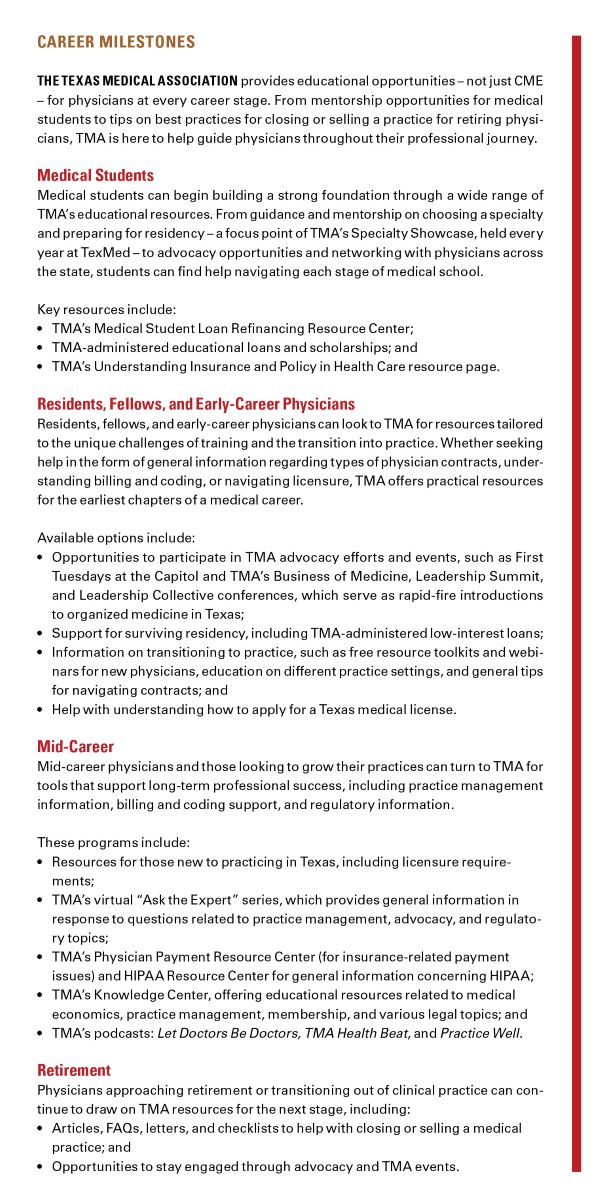
For example, TMA’s Physician Payment Resource Center provides hands-on education and assistance with payer policies, claims, and payment questions; the “Ask the Expert” virtual series features commentary and general information from professionals on compliance, practice management, advocacy, and regulatory topics; and TMA’s Knowledge Center helps members find answers to questions about practicing medicine in Texas.
Austin internist Anna Buteau, MD, said TMA’s multifaceted effort to share education with its members “doesn’t go unnoticed” by busy physicians such as herself. Among her favorite ways to stay on top of emerging topics: reading Texas Medicine Today, TMA’s e-newsletter, or listening to TMA’s podcasts – Let Doctors Be Doctors, TMA Health Beat, and Practice Well.
The podcasts explore topics ranging from practice management and regulatory updates to physician well-being. Dr. Buteau appeared on TMA Health Beat in February, where she detailed her work to improve her patients’ health through the Walk with a Doc outreach program.
“Having short episodes that I can listen to in between other tasks is really helpful in my own practice, and I’m glad I was able to help create something others can listen to quickly and easily as well,” the member of TMA’s Council on Health Care Quality said.
Help for every practice setting
As a physician who transitioned from an employed setting to private practice, Dr. Vasquez says she regularly directs colleagues to TMA’s online practice resources – there’s something for everyone.
TMA has expanded its practice offerings to meet the evolving needs of physicians, whatever their setting. For example, TMA recently created CME and other educational materials designed specifically for those in employed settings, covering topics such as employment contracts, compensation methods and financial questions, workplace relationships, and professional development.
TMA also provides education on the business aspects of various practice settings via its biennial Business of Medicine conference. Together, these resources help physicians better understand their rights and responsibilities as physician practice arrangements continue to evolve, says Temple palliative care physician Jennifer Fan, MD.
Although Dr. Fan, a member of TMA’s Council on Health Care Quality, was able to navigate her own contract negotiations with her employer, she says it was a great comfort to know great TMA educational resources were available.
“As the demographic of TMA changes … I feel confident in every resource TMA produces for its physicians,” she said.
Alisa Pierce
Reporter, Division of Communications and Marketing
(512) 370-1469