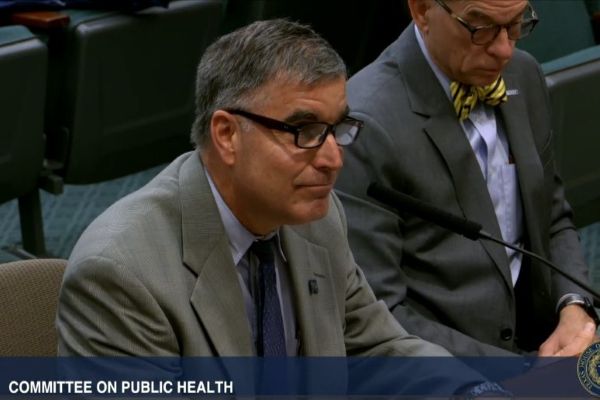
Acting on its interim charges, the Texas House Committee on Public Health recently held its first hearing in the runup to the 2027 state legislative session, where the Texas Medical Association offered up a long-term strategy to reduce rural health care workforce shortages by encouraging students from rural communities to pursue medical careers and return home to practice.
The Texas health care workforce is among dozens of priorities for the 2027 session announced this spring by Texas House Speaker Dustin Burrows. The House Committee on Public Health is charged with reviewing “the current and projected health care workforce shortage in Texas” and making “recommendations to reduce its impact on access to care and service delivery.”
Testifying on behalf of TMA on June 4, family medicine physician Adrian Billings, MD, described to the committee just how many physician roles he’s had to fill in Alpine, a West Texas city of 6,000 residents, in his nearly 20 years there. That list includes delivering babies, working in an emergency room, attending to house calls, and providing care to even smaller outlying communities.
“While this type of practice has been incredibly rewarding, it has also been exhausting owing to the incredible demand for health care in the Big Bend,” he stated in testimony.
As a solution, Dr. Billings proffered TMA’s 2025 legislative proposal to create a Rural Admissions Medical Program, or RAMP, to financially and academically incentivize rural students to enroll in medical school and return to their hometowns to train and to serve.
“To solve the rural physician workforce crisis, we must train more rural-origin medical students, and it is essential to provide more rural training for all medical students and resident physician trainees,” said Dr. Billings, a member of the TMA Council on Legislation and former member of the Committee on Rural Health.
The 2025 legislation, which did not pass, would have targeted counties with populations of fewer than 25,000 with financial and academic support to rural students who pursue medical school. Qualified students would have guaranteed admission to a participating state medical school.
“We must admit more rural students into medical school, and we have to enable more rural medicine exposure to trainees if we want to improve access to care for rural Texas,” Dr. Billings told committee members.
Dr. Billings also commended the legislature’s support for obstetrical training for family physicians, the interim study of the obstetrical physician workforce, and funding in House Bill 18 to help rural hospitals recruit and retain physicians – calling it a “much-needed investment in rural populations.”
Dr. Billings’ testimony dovetails with new policy the TMA House of Delegates adopted at TexMed 2026 in April strongly supporting pipeline programs to identify and support students “with attributes that are expected to be predictive of an interest in careers in rural medicine.”
Follow TMA’s legislative testimony and related Texas Medicine Today coverage on the state advocacy webpage.