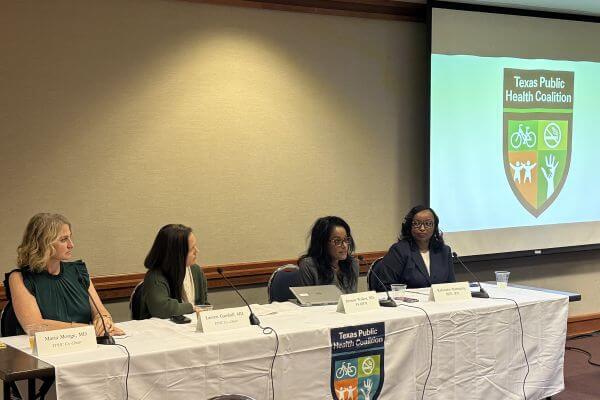
Public health initiatives can be invisible to the general populace when all is well, according to Texas health officials, but state lawmakers must continue to prioritize immunization funding and essential infrastructure to protect Texans and the state’s economic future.
During a panel discussion hosted by the Texas Public Health Coalition (TPHC) at the Texas Capitol, Desmar Walkes, MD, told the audience that lawmakers should view public health as an integral part of public safety.
Dr. Walkes, the medical director and health authority for Austin Public Health, and Rahmatu Mansaray, director of nursing for the Houston Health Department, were featured guests at the TPHC Distinguished Speaker Series event May 18 supported by the Texas Medical Association.
“If we could fund it like it’s a public safety arm of our society, which has been estimated many years ago being 5% of any annual budget, we could really go a long way to ensure the capacity and the ability for us to do the work,” Dr. Walkes said.
TPHC co-chairs Maria Monge, MD, and Lauren Gambill, MD, guided the speakers through topics ranging from the importance of immunizations to public health readiness, and rebuilding trust among patients – something Dr. Monge acknowledges is difficult to measure.
“Yet if you don’t have it, your public health infrastructure seems like it collapses because you can’t reach the people who it’s designed to help in the first place,” Dr. Monge said.
Dr. Walkes explained a thriving public health system has wide-ranging work happening behind the scenes. That includes, for instance, collaboration between physicians, nurses, and social workers to deliver immunizations to stop preventable diseases, care for patients in neighborhood clinics, and address nonmedical variables.
The system reaches further than some might expect. Inspectors check water for mosquito-borne illnesses. Health inspectors monitor food trucks and restaurants in response to reports of salmonella outbreaks. Public safety partnerships bolster readiness ahead of public health emergencies and large-scale events.
All of this requires funding, Ms. Mansaray emphasized.
“If the system is underfunded, a lot of things get deprioritized.”
TMA’s legislative efforts are key in making sure that doesn’t happen. Dr. Gambill recently submitted joint testimony on behalf of TMA, TPHC, and the Texas Pediatric Society before the Texas Department of State Health Services regarding their shared public health priorities for the 2027 legislative session.
Dr. Gambill’s testimony asked the state to support a broad range of issues on immunization services, infectious disease prevention, and maternal and infant health.
TMA and TPHC continue to look for ways to address vaccine hesitancy, an issue Dr. Walkes and Ms. Mansaray both highlighted during their panel.
Dr. Walkes estimated that health officials spend anywhere from $70,000 to $150,000 for every case of measles found in any civic jurisdiction, far more the cost of delivering two doses of the MMR vaccine, which runs approximately $10,000.
“The question we get is, ‘So what happens if I catch measles? We’re going to have a measles sharing party. We will build our own herd immunity on my block,’” Ms. Mansaray told the audience. “We have to approach that from, you know, that is your personal decision. Let's have a conversation on what that could possibly look like,” offering to walk families through potential health consequences two weeks, one to six months, and even 10 years later.
Dr. Walkes has also noticed motivation waning for immunizations.
“It’s interesting for me as a clinician to see patients that used to come in, roll up their sleeve every flu season as soon as the flu vaccine was available and say, ‘Where’s the shot?’” Dr. Walkes said. “Now, I’m having to ask them and answer questions about things they have never questioned before.” When it comes to vaccines, “the lie is halfway around the world before the truth gets its pants on.”
If physicians can’t do what is required to keep the public safe through vaccinations, studies have pegged the total economic cost at $540 billion. The societal and economic cost of not stopping vaccine-preventable diseases could land in the trillions, Dr. Walkes said.
“The importance of supporting [immunizations], not only for your at-risk populations, children and older adults, but also the healthy workforce, can't be overstated,” Dr. Walkes said.
The Texas Public Health Coalition consists of more than 30 health professional organizations and health-focused organizations dedicated to disease prevention and health promotion. The coalition works to reduce preventable disease by advancing effective public policies that promote a safe and healthy environment and healthy behaviors for all Texans.
For more information about TMA’s efforts at the Texas Capitol, visit the TMA State Advocacy page. Learn more about TPHC, including legislative priorities and successes, on their resource page.