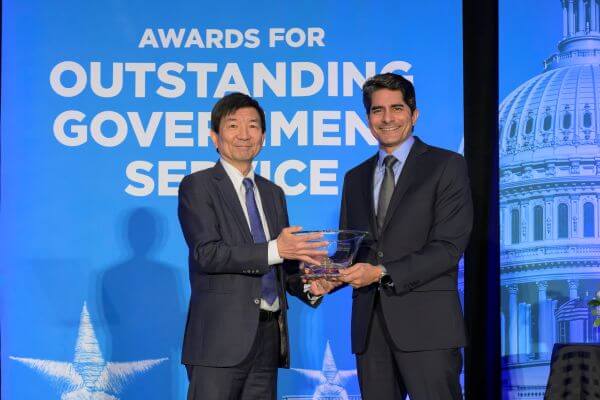
When Philip Huang, MD, looks back over his decades in public health, one constant runs alongside his work in city, county, and state government: the Texas Medical Association.
The longtime leader in infectious disease and chronic disease prevention has spent his career at the intersection of government and organized medicine, for which he received the American Medical Association’s Award for Outstanding Government Service on Feb. 25 at the organization’s National Advocacy Conference.
The director of Dallas County Health and Human Services since February 2019, Dr. Huang has “strengthened public health infrastructure, addressed chronic disease and HIV, and led efforts to modernize the county’s public health data systems,” the AMA said in announcing the news.
Dr. Huang was Dallas’ leading public health voice during the COVID-19 pandemic, after logging 16 years with the Texas Department of State Health Services and 11 more serving as health authority and medical director at the Austin Public Health Department.
"His decades of experience in public health have ensured that science, data-driven policy, and community engagement remain at the center of local health leadership,” AMA Board Chair David H. Aizuss, MD, said in a statement.
Whether the topic was Ebola preparedness, COVID-19 response, or sustaining the basic infrastructure of public health, Dr. Huang aimed to reinforce throughout his career that these are not abstract policy debates. They are decisions that directly affect patients and communities.
“Health isn’t just clinical medicine,” he told Texas Medicine. “It’s also public health. We’ve all seen through these different events that it’s all working together.”
Dr. Huang also played a vital role at the Texas Capitol, testifying before the legislature on vaccination policy, funding for the state health department, and smoke-free ordinances, a personal passion – he has testified at more than 40 city council hearings in support. He’s still frustrated that Texas lacks a comprehensive statewide ban but makes clear that organized medicine’s support mattered to current regulations.
“Restaurant and bar owners were saying they’re going to go out of business, and they don’t,” Dr. Huang said. He remembers looking at Texas comptroller data after smokefree bans went in place and “how the [restaurant and bar] revenues were not adversely impacted or sometimes went up.”
Dr. Huang has served as chair of TMA’s Committee on Infectious Diseases and was a member of the Council on Science and Public Health. His vantage point within government service also has given Dr. Huang a clear view of how TMA’s convening power, advocacy muscle, and physician voice impact the health of Texans.
“[TMA] was such an important organization for everything we were doing with public health in Texas, especially when I was at the state level,” he said.
Dr. Huang has no intentions of slowing down, remaining deeply rooted in Texas and in TMA’s orbit. He’s monitoring the use of artificial intelligence and how it affects physicians’ day-to-day work, as well as inspiring next-generation physicians as an adjunct faculty member at UT Southwestern Medical Center’s O’Donnell School of Public Health as well as the School of Public Health at UTHealth Houston.
“They’re the most inspiring hope for the future that they see the value of making an impact on their community,” Dr. Huang said.