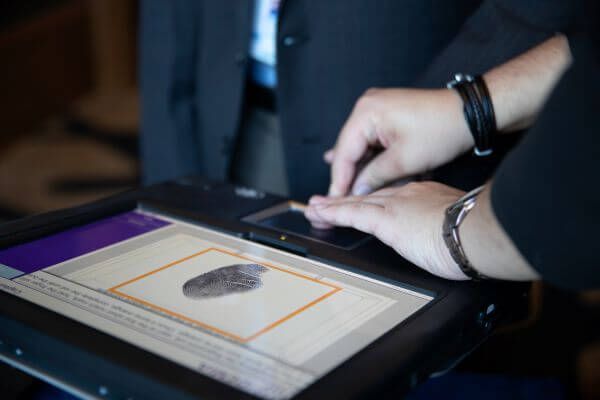
As fingerprinting requirements for medical licensure continue to catch some physicians by surprise, the Texas Medical Association is urging members to complete the process as soon as they are notified to prevent unnecessary interruptions to their ability to practice.
Failure to comply with Texas Medical Board (TMB) fingerprinting requirements could delay license renewal or reinstatement. This could result in an expired license, potentially exposing physicians to enforcement action.
TMB Director of Governmental Affairs and Communication Taurie Sloan told Texas Medicine Today that according to medical board records, there are roughly 2,200 physicians who still need to complete the fingerprint requirement. Of those, the vast majority are established physicians who need to complete the process to renew their licenses, she says.
Last year, Austin pathologist Leslie Dalton, MD, says a routine oversight led him to miss his fingerprinting deadline, resulting in a two-week lapse in his medical license, temporarily halting his ability to practice.
“By the time I realized something was missing, it was too late,” he told Texas Medicine Today.
Dr. Dalton says although he had started working on his license renewal before the deadline, fingerprint processing can take up to four weeks, in essence making his renewal deadline much sooner than he expected.
Things became even trickier for Dr. Dalton when he misplaced his six-digit ID number required for fingerprint submission. TMB issues the ID numbers through postcard and email reminders each renewal period. Without tthat number, physicians cannot begin the fingerprinting process.
In Dr. Dalton’s case, misplacing his ID number meant spending extra time communicating with TMB before he could schedule a fingerprint appointment, and by the time he was able to do so, he’d already missed his renewal window.
As a result of legislation passed during the 2023 session, TMB mandates that all physicians applying for or renewing their medical licenses must submit fingerprints for a background check as part of the licensure process. Similar legislation was previously passed requiring physician assistants and surgical assistants to be fingerprinted.
Physicians who were fingerprinted for licensure applications after Jan. 15, 2018, are exempt from this requirement. According to TMB, those fingerprinted prior to that date must undergo the one-time process that began with February 2024 renewals.
Per TMB, email renewal reminders are sent 60 to 90 days before a license’s expiration date. Those emails will come from no.reply@tmb.state.tx.us. Detailed instructions on how to complete the fingerprinting are included in the email reminders.
TMA encourages members to begin the fingerprinting process early, as fingerprint background check results are required before physicians can access the online registration.
The medical board says on its website that physicians can complete the fingerprint requirement at any point prior to a license expiration date, including before the 60-to-90-day window of license renewal. To submit fingerprints early, physicians must contact TMB registrations@tmb.state.tx.us and request instructions. However, TMB cautions that “completing your fingerprints before your renewal period will not enable you to renew your license early.”
According to TMB’s website, physicians cannot receive fingerprints from any fingerprinting service other than through IdentoGO. Physicians are subject to a $38.25 processing fee, which is due at application time and includes processing fees for the fingerprint vendor, Texas Department of Public Safety, and FBI.
Although his license was ultimately reinstated, Dr. Dalton says the disruption was avoidable.
“Physicians need to ensure they’re keeping track of each of this process’ requirements. Look for that six-digit number and schedule fingerprinting early,” he said.
Continue to read TMT for updates. If you have questions or concerns, contact TMB.
DISCLAIMER NOTICE: This information is provided as general information and is not intended to provide advice on any specific legal matter. This information should NOT be considered legal advice and receipt of it does not create an attorney-client relationship. This is not a substitute for the advice of an attorney. The Office of the General Counsel of the Texas Medical Association (TMA) provides this information with the express understanding that (1) no attorney-client relationship exists, (2) neither TMA nor its attorneys are engaged in providing legal advice, and (3) the information is of a general character. Although TMA has attempted to present materials that are accurate and useful, some material may be outdated, and TMA shall not be liable to anyone for any inaccuracy, error or omission, regardless of cause, or for any damages resulting therefrom. You should not rely on this information when dealing with personal legal matters; rather legal advice from retained legal counsel should be sought. Also, this information contains third-party links that may bring you to a third party website, owned and operated by an independent party over which TMA has no control (3rd Party Website). Any link you make to or from the 3rd Party Website will be at your own risk. Any use of the 3rd Party Website will be subject to and any information you provide will be governed by the terms of the 3rd Party Website, if any, including those relating to confidentiality, data privacy and security.