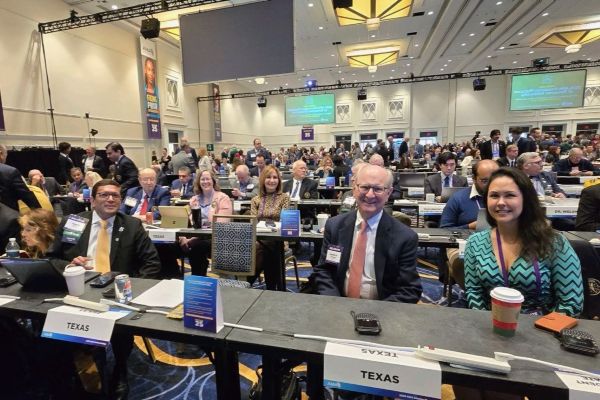
In a dynamic, collaborative forum, more than 30 physicians and medical students from the Texas Delegation joined nearly 2,000 colleagues from around the country at the American Medical Association’s Interim Meeting, scrutinizing and advancing national policies that safeguard physicians' professional autonomy while expanding access to high-quality patient care.
Held Nov. 14-18 at the Gaylord National Resort & Convention Center in National Harbor, Md., the meeting exemplified the power of participation in organized medicine, with the Texas Delegation's contributions amplifying Texas' influence on a national stage, says Chair Michelle Berger, MD.
“We were all reminded the path forward demands active participation,” she said. “Here's to more voices, fewer barriers, and healthier patients in 2026 and beyond.”
Underscoring AMA's role in navigating today's complex health landscape, CEO John Whyte, MD, launched the meeting with his vision for redefining the organization’s legacy and fortifying organized medicine amid pressing challenges like administrative burdens, physician burnout, workforce shortages, and the rise of generative artificial intelligence. He positioned AMA not as a passive observer but as an active "architect" of health care's future.
“The future of the AMA is not something we wait for. It’s something we shape, with urgency and unity,” Dr. Whyte said. To strengthen the organization, he called for bridging divides across generations, specialties, and ideologies, asserting: “We must work together, because truly together, we have more power.”
The meeting's momentum continued with a presentation by Centers for Medicare & Medicaid Services Administrator Mehmet Oz, MD, MBA, in which he urged physicians to speak out even when their views challenge the status quo. He emphasized physicians have a vital voice in health care reform and must participate in the process to drive change.
Drawing from his dual perspective as a surgeon and policy leader, Dr. Oz spotlighted innovative strategies to slash costs and boost patient access, including a “gold card” prior authorization process – akin to what Texas already has initiated – that would exempt high-performing physicians with an 80% or higher prior authorization approval rate from routine bureaucratic hurdles, reducing delays, paperwork, and patient hassles.
Texas Highlights
Citing state legislative successes to influence national discourse, the Texas Delegation played a pivotal role in advancing key policies, among other standout moments.
- Saying farewell to a leader: Gary Floyd, MD, a steadfast delegation participant for over 20 years, announced his retirement following next year’s AMA Interim Meeting. In a heartfelt address, he encouraged emerging leaders interested in running for vice chair in January to reach out to Delegation Chair Michelle Berger, MD, or himself for guidance. Dr. Floyd will serve as vice chair emeritus at AMA’s 2026 Annual and Interim Meetings, offering mentorship to ease his successor’s transition.
- Leveraging Texas wins: Texas' legislative achievements were instrumental in the AMA House of Delegates, propelling a resolution modeled after efforts in Texas but going further. The adopted resolution directs AMA to advocate to ban non-compete clauses in physician contracts, preventing undue restrictions on practice mobility and patient choice.
- Streamlining prior authorizations: Building on cost-reduction efforts, the house also directed AMA to advocate that low-cost medications and procedures should not require prior authorization, aiming to ease administrative burdens and accelerate care delivery.
- Combating scope creep: Several policies were approved to guide AMA advocacy on physician-led care, including evaluating the impact of specialty switching by nurse practitioners and physician assistants on patient care costs and quality. Other policies seek legislation to:
- Prohibit deceptive advertising in accredited allied health professional and nonphysician graduate programs to ensure transparency and protect patient safety.
- Mandate that laser surgery be performed only by licensed physicians.
- Support doula services for nonclinical peripartum and birthing support, provided doulas hold appropriate registrations, licenses, certifications, liability insurance, and collaborate within a physician-led team.
- Safeguarding employment contracts: The house endorsed developing model state legislation to prohibit indemnification clauses in physician contracts that shield employers from liability. AMA also will ramp up education on the risks of contracts requiring physicians to cover tail insurance or indemnify employers, promoting informed negotiations.