
San Antonio internist Amith Skandhan, MD, says artificial intelligence (AI) has the potential to change health care for the better – with a few caveats.
His most pressing concerns: Do physicians understand which tasks are or are not suited for AI, how to use AI while safeguarding protected health information, and are they aware of the legal requirements associated with their particular use(s) of AI?
The Texas Medical Association’s policy on AI and augmented intelligence in health care asserts the technology should be used as a tool set with physicians at the lead to support physician decision-making, enhance patient care, and improve public health.
“Even though I’m pro-AI, I feel you should still look at it with skepticism. It’s a tool … but it’s not replacing you,” said Dr. Skandhan, a consultant to TMA’s Committee on Health Information Technology and Augmented Intelligence. “AI does not place orders; you still have to make that decision. Physicians are the ones who hold the license to practice medicine in this state.”
Over the past few months, Texas Medicine has spoken to physicians across the state who utilize AI technology within the bounds of state and federal law to optimize their workflows, resulting in more time with patients and less time spent on administrative tasks.
These physicians have implemented additional steps and processes to reduce liability associated with their use of AI under Texas and federal law, such as HIPAA. From AI-generated discharge summaries to contract review, here’s a look at these physicians who have gone the extra mile to make AI work for them and their patients.
Why One Physician Uses ‘As Many AI Tools as Possible’
Artificial intelligence (AI) streamlines almost every aspect of Ogechika Alozie, MD’s, practice – and he encourages other physicians to use the technology “help the practice of medicine evolve.”
Although the El Paso infectious disease specialist said he uses AI “in any way that suits medicine” – including for clinical decision support, treatment recommendations, and help with billing and payment – he’s careful about what platforms he uses and when.
For instance, Dr. Alozie uses OpenEvidence – a free, AI medical information platform that features content from the New England Journal of Medicine and JAMA – to craft patients’ treatment plans and edit clinical documentation necessary for billing, payment, and continuity of care.
To do this, he uploads lab reports and his own deidentified notes into the platform, which recommends appropriate treatment plans based on his clinical insight and evidence supported by medical literature. The technology also drafts supporting documentation to ensure clarity.
“AI makes justified changes to my care plans based on new and existing research,” the past chair of the Texas Medical Association’s Committee on Health Information Technology told Texas Medicine. “It has [strengthened] my medical decision-making as a whole.”
Dr. Alozie never puts patients’ protected health information into AI platforms that are not HIPAA-compliant, like ChatGPT. He only uses these applications for tasks unrelated to patient care, like examining his billing and collections to make informed decisions about which hospitals he and the nurse practitioners he employs will visit for rounds – or for analyzing complex contracts, such as building leases.
For the former, he asks ChatGPT to provide insight into patient demographics, insurance coverage, and hospital performance metrics to make decisions on rounds. After eight weeks of doing this, Dr. Alozie says his practice saw a 20-25% increase in revenue.
He also asks the platform to review and flag unfavorable terms and potential financial risks within a contract, a feature he called “one of the biggest advantages” to using the technology. However, Dr. Alozie still consults with his own legal counsel before signing any agreements.
By using AI, Dr. Alozie says he’s able to grow his private practice, eliminate unnecessary work, and free up time for more meaningful patient interactions.
“I’m using as many AI tools as possible to make my life as simple as possible,” he said.
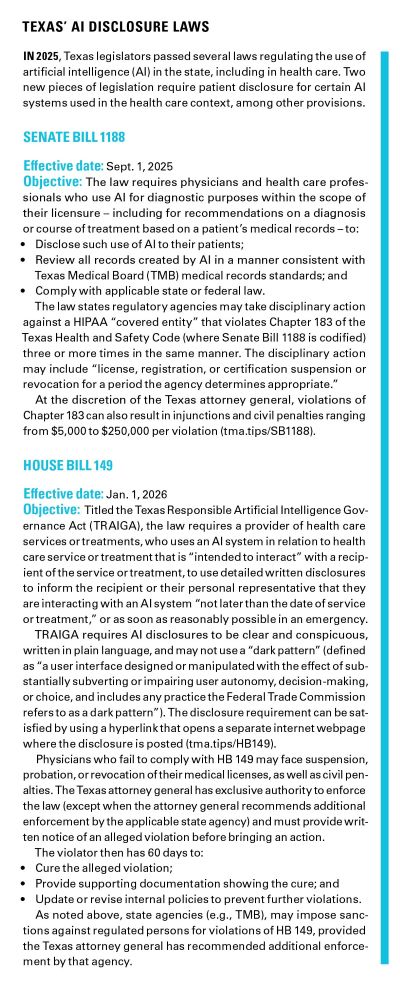
Dr. Alozie discloses his use of AI to patients before every appointment as required by Texas law, which mandates certain disclosures when the technology is used for diagnostic purposes, including recommendations on a diagnosis or course of treatment, as well as when a patient “interacts” with an AI platform.
He also chooses to verbally request consent from patients before he uses AI during an appointment as an added layer of communication, although Texas’ laws do not mandate that he do so.
His patients have increasingly accepted the technology, Dr. Alozie says. However, he still finds some physicians remain skeptical about using AI. While he understands their hesitation, he encourages clinicians to use the technology to “help the practice of medicine evolve.”
Access to AI ‘Almost Effortless’ With EHR
A group of academic physicians in Galveston are now conducting almost every patient visit with the assistance of artificial intelligence (AI), reducing administrative hassle.
At the University of Texas Medical Branch Health Adult Primary Care clinic, every health care professional now uses an AI-powered clinical documentation tool that records and writes notes in real time.
Clinicians like League City family physician Renny Varghese, MD, are finding that AI tools – “when used with care,” he said – can help address the leading causes of burnout: paperwork and administrative responsibilities, according to the American Medical Association.
Dr. Varghese says his practice transitioned to AI transcription services because they were more affordable than previous scribing methods. His favorite part? The technology is fully integrated within the electronic health record (EHR), making physicians’ access to the technology “almost effortless,” the member of the Texas Medical Association’s Committee on Health Information Technology and Augmented Intelligence said.
From the EHR, AI transcription can be turned on at the start of appointments, leaving clinicians able to focus entirely on the patient in front of them. However, Dr. Varghese says every physician at his clinic still checks the AI’s work to ensure notes are accurate and easy to read.
He and other physicians at the clinic disclose their use of AI to patients before every appointment. Dr. Varghese also chooses to verbally request consent from patients, and he notes their AI preferences within their medical records.
Dr. Varghese’s patients use AI at home, too, and he’s regularly questioned both in-person and via online patient portals about AI-generated health information. He sees such instances as an opportunity for physicians to both listen to their patients’ concerns and communicate when and how the technology should be used in the medical space.
His approach has led his patients to become more comfortable with AI-based systems in appropriate settings – only three of his patients have declined when asked for consent to use them during their visits. He also says open communication with patients makes them less likely to rely on AI-generated information rather than clinical expertise.
“It’s important for physicians to seek ways to spend less time with the paperwork and more time with the patient,” Dr. Varghese said.
‘Hands-Free’ Patient Care Courtesy of AI
Emergency room physician Stephen Stewart, MD, who splits his time between a level one trauma center in Lubbock and a critical access hospital in Pagosa Springs, Colo., uses a HIPAA-compliant artificial intelligence (AI) application to record and document patient visits.
With the patient’s consent, he places his phone nearby during the visit so the application can record the conversation, transcribe it in real time, and automatically generate clinical notes in the electronic health record – allowing him to “focus entirely on the patient in front of him,” he told Texas Medicine.
The system uses what is called natural language processing – a branch of AI that works to understand, interpret, and generate human language – to identify medically relevant details, such as symptoms and treatment recommendations, and organizes them into a document physicians like Dr. Stewart can then review and approve. That way, Dr. Stewart can provide patient care with a more hands-on approach – or, in this case, a “hands-free” approach, he said.
He says the AI documentation platform has been especially helpful during fast-paced emergency visits, including one instance when he used it to document care for a patient with lacerations requiring immediate attention. The AI captured his discussion with the patient while he was busy suturing and then turned that conversation into a clear procedure note. A 2024 study in JAMA Network noted emergency department physicians spend a median of 6.82 minutes per encounter with a patient.
“By the end of a visit, the AI has already captured my treatment plan and after-care instructions,” he said. “It’s just me and two nurses out at the hospital in Colorado. If I was having to do the charts manually, there’d be a lot more patients waiting for care. And secondly, I’d be staying a lot later after my shift to get my documentation done.”
Dr. Stewart discloses his use of AI to patients before every appointment. After reading a Texas Medicine Today article detailing Texas’ disclosure requirements, he began posting a notice in his patients’ portals.
Dr. Stewart also uses ChatGPT to write discharge instructions for patients. However, he never putspatients’ protected health information into ChatGPT. Instead, he replaces all patient identifiers – including name, date of birth, and address – with general placeholders. A prompt could read, for example, as something as general as “middle-aged male presenting with high blood pressure.”
ChatGPT then generates a discharge summary that includes potential lifestyle modifications and follow-up care. However, Dr. Stewart said physicians still need to treat the technology as a “drafting tool, rather than a reference.”
“There are a lot of things that just aren’t focused on emergency medicine, so we have to figure out how we can use [AI] made for others in ways that still work for us,” he said. “The key is to treat AI as an assistant.”
Warning: AI Tools Not Always Compliant
San Antonio internist Amith Skandhan, MD, is “very optimistic” that artificial intelligence (AI) will positively transform health care – so long as physicians understand how to use the technology appropriately.
Physician practices can take certain steps to comply with Texas and federal law (e.g., HIPAA). For example, physicians can review their AI systems, patient policies, disclosure and consent procedures, and how an AI tool – and the data it collects – is used by vendors to further compliance efforts.
However, Dr. Skandhan, an associate professor for the University of Texas Health San Antonio’s Division of Hospital Medicine, worries “well-intentioned” physicians may stop there. For example, he said, physicians may use an AI tool that is HIPAA compliant without obtaining proper approval from their institution or practice – a practice he calls “shadow AI.”
Last year, 57% of health care professionals encountered or used an AI platform unauthorized by their institutions, according to a January 2026 survey by Wolters Kluwer, a multinational company that provides information software and services across multiple sectors, including health care.
HIPAA-compliant tools meet technical, administrative, and contractual requirements mandated by HIPAA to safeguard patients’ protected health information, such as by employing end-to-end encryption and being designed with a compliance framework in mind. On the other hand, an institution’s/practice’s approved tool is evaluated by hospitals and other health care systems to ensure it meets that institution’s specific policies, standards, guidelines, and duties under HIPAA (e.g., obtaining certain assurances from the AI tool’s vendor, entering into a business associate agreement with the vendor, etc.).
Dr. Skandhan says the practice of shadow AI becomes even more worrisome as some vendors have begun to include so-called indemnification clauses in their contracts that place some liability on physicians.
These clauses may outline, for example, that while the AI developer is liable for output or usability issues that harm patient care, hospitals and physicians will shoulder the blame for errors arising from poor deployment or misuse of the technology, explains a study from the University of Stanford’s Institute for Human-Centered AI.
Dr. Skandhan said using AI technology in health care “becomes concerning” when physicians “perceive compliance.”
Although Dr. Skandhan says he uses AI across multiple fronts, from research writing to drafting educational materials for his students, he does so only after reviewing the product’s compliance with Texas and federal law – and recommends other physicians do the same.
From there, if they’re in an employed setting, he recommends communicating with their institutions about which AI systems are approved and for what reasons, and what safeguards the facility has in place to prevent breaches in patient data. He recommends independent physicians, on the other hand, create AI governance policies that clearly outline how they will use these technologies in their practice.
He also advises physicians extensively review all contracts with AI developers before signing, and with a lawyer with experience in technology and health care contracts.
“[AI] has so much potential,” Dr. Skandhan said. “We need better governance. We need to understand what kind of data we are using, what kind of tools we are using, and how and when to use them. As we have these conversations over and over again, we’ll get to that point. The work is just slow and steady.”