“Social media is the new waiting room.”
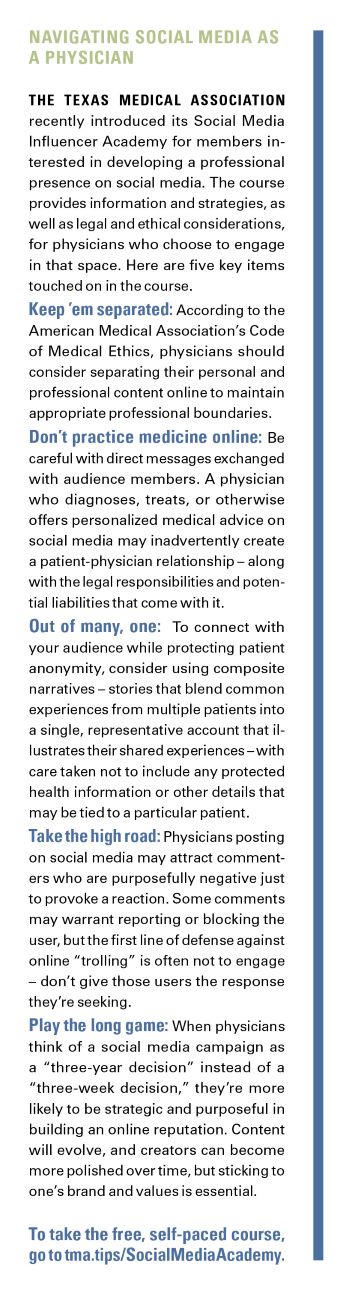
That’s the opening declaration made in the Texas Medical Association’s new Social Media Influencer Academy, a non-CME video course launched in December 2025 and available in the TMA Education Center.
Citing a 2021 Pew Research Center study that found 72% of adults who use the internet look online for health information – and noting that “misinformation is rampant” – the course equips physicians who want to deliver quality health information through social media with the know-how to reach an audience of patients hungry for it.
“The fear that a lot of people have, when they want to establish a social media presence or market themselves is that, ‘This is too hard,’” said Eddie Patton, MD, an advisor to TMA’s Committee on Health Information Technology and Augmented Intelligence, who reviewed portions of the course before launch in his former role as Council on Health Promotion chair.
The academy reflects a growing recognition at TMA that physicians’ digital presence has become increasingly important. As more and more patients arrive in exam rooms shaped by what they’ve seen on TikTok, YouTube, and ChatGPT, the course – and the physician members championing it – aims to help Texas doctors counter misinformation, build patient trust, and be present in the spaces where people seek health information.
“TMA has done a good job of simplifying it and saying that as long as you have a phone and a voice, you can be an influencer,” Dr. Patton added, noting that getting started doesn’t require fancy equipment or a large pre-existing audience.
He speaks from experience. In 2024, he launched the Your Health, Your Wealth podcast on YouTube, Apple Podcasts, and Spotify, and is approaching the 50-episode mark on a twice-monthly cadence.
“I started it to talk about a lot of the things that you don’t get to talk about in the doctor’s visit that patients ask about … like why medications weren’t approved, or why the health insurance [company] is requiring prior authorization,” the Houston neurologist said.
Through the podcast, Dr. Patton says he wanted to be a resource and reference for fellow physicians on medical-economics topics.
As his audience and reputation have grown, Dr. Patton has appeared on other creators’ podcasts and returned the favor – expanding his reach, sharpening his own knowledge, and reinforcing why TMA is focused on this space.
“Others are thirsty for good medical knowledge,” he said.
Medicine meets social media
The course grew out of a 2024 TMA Board of Trustees discussion about how to better serve physicians who want to build their social media presence – and add value to association membership in the process, said TMA President-Elect Kimberly Monday, MD.
“Traditionally, physicians have not been out there communicating directly with the public online. It’s a different sort of culture that a lot of the older doctors were not comfortable with,” she said.
Social Media Influencer Academy, while also providing legal and ethical considerations, offers “actionable steps for those who were not as engaged or who didn’t have that experience or grow up in that culture,” she said.
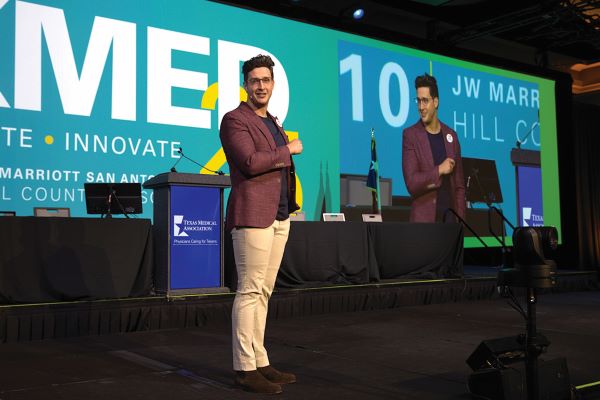
Mikhail “Doctor Mike” Varshavski, DO – the most-followed physician on social media – anchored that message at TexMed 2025’s closing session in San Antonio.
“Misinformation that’s posted to social media spreads faster than accurate information,” he told the audience, adding that he was personally working to change that in the health care space.
Dr. Mike’s appearance at TexMed wasn’t coincidental, Dr. Monday said. He exemplifies how physicians – even those who “didn’t go into this to be in the spotlight” – can communicate effectively on social media.
“It was about getting comfortable with putting yourself out there, having an opinion, and knowing what you can and can’t say and do,” she said. “He told the audience and reassured them that, as long as physicians stay within the bounds of truth, reaching patients through social media is an opportunity to educate them.”
The 92-minute self-paced video course is organized into 11 sequential chapters. It opens with foundational topics – defining a niche, setting goals, building a brand, and minding legal and ethical boundaries – then walks through the major platforms (Instagram, LinkedIn, TikTok, and YouTube) and how to craft messages and tell stories effectively on each.
The course also introduces the concept of three to five “content pillars” – consistent topics that establish “repeatable lanes” for individual posts and help creators avoid the “random post” that deviates from core messaging and undermines credibility.
Other chapters guide busy physicians through content systems and tools to streamline the process, structuring and producing a podcast, and managing misinformation, public backlash, and reputation over the long term.
Throughout, the course emphasizes connection with audiences.
“Clear, simple and compassionate messaging doesn’t just inform – it connects,” Chapter 4 says. “When your audience feels connected, they trust you, remember you and act on your message.”
Prescription: More trusted voices
While the course is billed for physicians seeking influencer-scale audiences, it also delivers value to physicians who simply want to better understand social media and the process behind the content they’re consuming.
Binh Higley, MD, a Houston anesthesiologist whose online activity centers on Facebook, came across the course while browsing CME offerings in TMA’s Education Center.
Its focus on combating misinformation prompted her to reflect on what her patients are encountering online – and to consider “trying to change patient minds on what they hear versus what’s actually available to them.”
“People can definitely need a little more education with anesthesia,” said Dr. Higley, who is now considering creating social media content about her specialty. “I don’t see a lot of anesthesia-related [posts] out there.”
As president-elect, Dr. Monday has studied how the three TMA presidents before her have embraced social media – including Jayesh “Jay” Shah, MD, who launched the Let Doctors Be Doctors podcast through TMA during his term.
She aims to lean further into social media in the coming year. A strong online presence, she says, can be a valuable asset when leading TMA’s more than 60,000 physicians – especially with the 2027 session of the Texas Legislature approaching.
“I think it’s like any habit,” she said. “Once you start to do it regularly, it’s much easier.”
And whether a physician’s audience is large or small, every post has the potential to go viral – important in an era when patients are as likely to consult Google or ChatGPT as they are a physician.
“It’s important for physicians to have a voice to combat some of the noise, some of the incorrect information regarding health and health care conditions that’s out there right now,” Dr. Patton said.
Phil West
Associate Editor
(512) 370-1394
phil.west[at]texmed[dot]org

Phil West is a writer and editor whose publications include the Los Angeles Times, Seattle Times, Austin American-Statesman, and San Antonio Express-News. He earned a BA in journalism from the University of Washington and an MFA from the University of Texas at Austin’s James A. Michener Center for Writers. He lives in Austin with his wife, children, and a trio of free-spirited dogs.