Through its Education Center, the Texas Medical Association makes CME accessible at a physician’s fingertips, for those who want to watch a video online, download and absorb a podcast, or read a publication they can reference later.
But sometimes, it’s just more fun to learn in a room with others – especially when wine and cheese are involved.
Kelly Green, MD, in her leadership role with the Burnet-Lampasas-Llano County Medical Society, wanted to bring physicians together this past January for a CME session on legislation, and knew TMA coordinated such educational opportunities through its Ambassador Program.
“It’s especially challenging because we don’t have an administrator, we don’t have a building, and we don’t have an office,” she said of her county medical society. “It’s just whichever one of us decides to lead the show that year.”
But it was important for Dr. Green to provide an opportunity for the county medical society’s physicians to get together.
“I like getting our doctors to see each other in person and share cell phone numbers,” she told Texas Medicine. “It really helps facilitate patient care, and patients love it when they know that we know each other.”
She says it was incredibly easy to work with the association to schedule a speaker – in this case, then-TMA President-Elect Bradford W. Holland, MD, who ran his CME session as more of a conversation than a presentation.
Then, it was just a matter of finding a venue. House of Cheese in Marble Falls stayed open after hours, accommodating close to 25 physicians from the three counties who gathered, learned, and tallied CME while getting to know a locally owned business.
That’s just one example of the live, in-person experiences that TMA curates for members looking to bank CME credits while in the company of colleagues.
Through the Ambassador Program, groups of geographically aligned physicians can gather and learn. Through the association’s slate of conferences – including the Local Medicine Matters series, TexMed, and the fall meetings built around the business of medicine and leadership – CME is an essential feature that makes those networking opportunities more enticing for physicians.
Live CME, no matter where delivered statewide, is woven into TMA’s historical fabric. According to former TMA President James Rohack, MD, when he joined the association as a medical student in 1976, the association was already providing live CME at conferences.
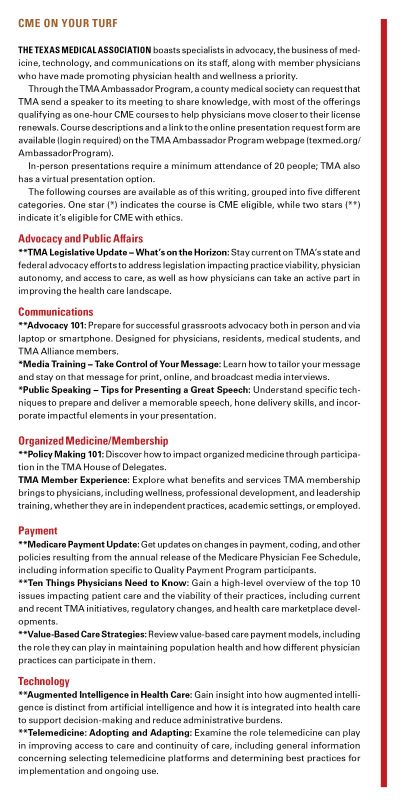
The evolution of TMA’s live CME options includes the creation of the Ambassador Program, which allows physicians statewide to arrange for the association’s subject-matter specialists to travel to them and deliver presentations.
Renny Varghese, MD, in his role as president of the Galveston County Medical Society, arranged for a presentation for members and nonmembers by TMA Director of Public Affairs Ben Wright in March. Close to 30 physicians attended to learn more about what happened in the Texas Legislature’s 2025 session and what’s on the horizon heading into next year.
“This meeting was to show what TMA does for physicians locally and statewide, and the pressing issues and concerns that we’re facing as a state, and to encourage our members to get more involved,” Dr. Varghese told Texas Medicine.
Attendees were so engaged by Mr. Wright’s presentation that some stayed after to ask questions. Among them was George W. Browne, MD, who had been contemplating joining the Galveston County Medical Society when he learned of the live CME session. He ultimately joined both TMA and the county society. Eager to repeat the event’s success, Dr. Varghese and a county society administrator arranged for another session to take place Sept. 24 – this time involving Dr. Holland.
“That shows how TMA is accessible, even with our leaders,” said the Galveston family physician of Dr. Holland’s willingness to travel and provide live CME. “There’s engagement from the top, and it’s not siloed … There’s direct communication, and engagement, networking, and connections, and hopefully that will translate to more involvement from our own members in our county.”
The Ambassador Program also involves doctors who prepare CME on physician health and wellness, delivering sessions – which count toward ethics CME requirements – to colleagues invested in their well-being.
“You value health and wellness just by showing up to the talk; you value professional camaraderie just by showing up to the talk. Those are both very important,” said Bethany Powell, MD, who has been involved in TMA’s outreach for more than a decade, first joining its Committee on Physician Health and Wellness in 2015.
The Galveston family physician, who knows the pressures of maintaining an independent practice firsthand, presents on a variety of topics, including preventing physician suicide, as part of a team of TMA physicians working collaboratively to ready presentations and then deliver them. She sees emotional intelligence as a throughline connecting all the physician health and wellness programs – essential to keeping physicians healthy for their patients.
“By improving your emotional intelligence, you reduce the risk of burnout, error, litigation, and turnover,” Dr. Powell said, instructing physicians, “Put on your emotional intelligence belt.”
TMA also makes live CME courses part of its conferences – most notably at the annual TexMed. Sessions come together at the end of a months-long process in which TMA fields an estimated 30 to 40 submissions, enlists a committee of physicians to review the proposed courses, and works with what will fit the schedule and physical conference space.
TMA also collaborates with specialty societies like the American Academy of Family Physicians to present specialty-specific CME courses on Thursday – the day before the conference officially starts – to help physicians grow and develop in their day-to-day practice areas.
At TexMed 2026 in Corpus Christi, the association had 30 distinct courses for attending physicians, delivered by member physicians who went through the application process.
In addition to various ethics, wellness, and leadership topics, TMA made available a number of technology CME courses aimed at demystifying complex subjects.
At the 2025 Business of Medicine Conference in El Paso – TMA’s fall conference that year – much of the CME focus was on artificial intelligence and its emerging role in medicine, including how physicians harness what TMA terms “augmented intelligence” to support clinical decision-making. For the upcoming Leadership Summit on Sept. 17-19 in Irving, CME will focus on leadership topics including how to manage important conversations and how to participate in TMA’s House of Delegates.
Because Local Medicine Matters aims to bring a conference experience to physicians in a particular region, its CME programming is similar to TexMed’s – offering variety that appeals to a broad cross-section of attendees. The latest event in Abilene delivered CME courses on practical uses of augmented intelligence in medicine, as well as an update on the latest news around vaccines and patients’ health, among other topics – and featured a mix of physicians and TMA staff as speakers.
Luissa Kiprono, DO, a maternal-fetal medicine specialist who leads a telemedicine-based practice in San Antonio, delivered a live CME course at TexMed 2026 titled “Telemedicine: Broad Vision Solution for the Future,” building on a similar presentation she gave at TexMed 2025.
“I spent my career caring for women in high-risk pregnancy, and one thing became very clear through my 20-year career: Too many patients were limited by geography rather than by medicine,” Dr. Kiprono told Texas Medicine. “So many high-risk patients have to drive hours just to spend half an hour, 45 minutes, an hour and a half, depending on their pregnancy indications, in a doctor’s office.”
She sees telemedicine as one important strategy for expanding access to maternal-fetal medicine in maternity care deserts and other underserved communities. More patients are familiar with how telemedicine works as a result of the COVID-19 pandemic, she notes, and she wanted to share her experience using it with physicians at TexMed.
Calling TMA’s CME application process “user friendly,” Dr. Kiprono retooled her 2025 presentation, making sure it was pragmatic enough for physicians who wanted to learn specific strategies for conducting a telemedicine appointment with a patient.
“I just walk through the entire visit and how it works, and really, that’s what they want to hear,” she said. “That’s how we [physicians] are. Don’t sugarcoat it.”
She enjoyed the experience of presenting to colleagues.
“I had at least three participants who came the year before. One of them reached out to me last year and said, ‘I’ve heard many presentations about telemedicine, and yours stuck with me.’”
The live presentations prove enriching for audience members as well as presenters. Scott Krall, MD, former chair of TMA’s Committee on Continuing Education and the current chair of its Subcommittee on Accreditation, says that the audience’s ability to ask questions in a live setting allows them to get more specific and detailed information than they would in a video or podcast presentation, and has the potential to be more dynamic as well.
“Most speakers feed off the interactions with their audience,” the Corpus Christi internist told Texas Medicine. “It’s going to energize the speaker because someone’s listening to them and someone’s asking questions … to me, that improves the presentation.”
Nancy Binford, MD, immediate past chair of TMA’s Women Physicians Section and a current member of its Committee on Medicaid, CHIP, and the Uninsured, agrees with Dr. Krall, comparing the experience of in-person learning favorably to the on-screen Zoom and Teams meetings that are part of her routine.
“Question and answer sessions are more robust in person because of gesture and reading the room,” the Austin obstetrician-gynecologist told Texas Medicine, calling interactions between presenters and audience members “so much more fluid.”
And even though Evan Pivalizza, MD, a member of TMA’s Council on Medical Education, earns the bulk of his CME via his academic setting at The University of Texas at Tyler School of Medicine, he still enjoys live CME sessions at TexMed, making it a point to take some in while at the annual conference. He values the “community aspect” of those sessions, while noting live CME also allows physicians in the audience to engage one-on-one with those leading sessions.
“Sometimes you’ll see when something finishes, there’s always five, six, 10 people up at the front asking questions that maybe they didn’t want to ask in front of the entire audience,” he said.
Phil West
Associate Editor
(512) 370-1394
phil.west[at]texmed[dot]org

Phil West is a writer and editor whose publications include the Los Angeles Times, Seattle Times, Austin American-Statesman, and San Antonio Express-News. He earned a BA in journalism from the University of Washington and an MFA from the University of Texas at Austin’s James A. Michener Center for Writers. He lives in Austin with his wife, children, and a trio of free-spirited dogs.