When given the nod to chair a reference committee at TexMed 2026, Jennifer Fan, MD, had a first reaction that it would be “definitely out of my comfort zone.”
Her second was a deeper realization. “This is a supportive community,” the Temple palliative care physician told Texas Medicine. “They’re asking me to do this because they believe in me.”
That belief was earned over years of leadership work inside the Texas Medical Association – a journey that began when Dr. Fan, as an El Paso medical student, watched physicians she most respected pour time into their local county medical society.
“What attracted me most to [organized medicine] is that the physicians whom I respected the most were involved in the local county medical society,” said Dr. Fan, citing her role model, the late Richard McCallum, MD, a former El Paso County Medical Society president. The medical society also brought Dr. Fan to First Tuesdays at the Capitol, where she got her first taste of advocacy.
That pathway is exactly what TMA aims to cultivate. Leadership paths run through county medical societies; boards, councils, and committees; sections; the Texas Delegation to the American Medical Association; the application-based Leadership College for early-career physicians; the self-paced Lifelong Leadership Program; and education and networking at TMA events.
For Dr. Fan, a Resident and Fellow Section (RFS) role on TMA’s Council on Science and Public Health opened a door to the association’s inner workings. Between that role and her seat on TMA’s Committee on Physician Distribution and Health Care Access, by the time she finished her residency, she was hooked.
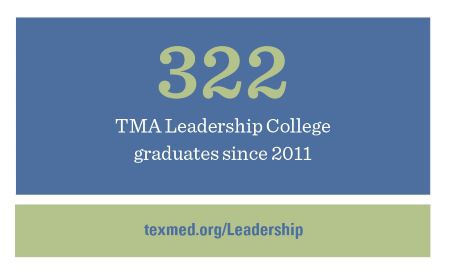
Eager to expand her leadership and advocacy skills, she applied to the Leadership College, TMA’s one-year program for physicians in their first eight years of practice. For physicians beyond the early-career window, the Lifelong Leadership Program offers a self-paced, open-enrollment opportunity blending in-person and virtual learning.
“I’ve never, before Leadership College, done something so distinctly to invest in myself,” said Dr. Fan, who serves as vice president of the Bell County Medical Society. “All of medical training feels like you’re sacrificing and sacrificing and sacrificing, and this was finally like, I’m doing this for me."
Medical students, residents and fellows, young physicians, international medical graduates, and women physicians are automatically admitted to their respective sections based on demographics (though other physician members outside the demographic may request to join the International Medical Graduate and Women Physician sections). The LGBTQ Health Sections is opt-in for any active TMA member. From there, physicians can voluntarily choose to participate in section meetings, policymaking, and other activities by letting section staff know.
Each section has its own elected executive council, and representatives recommended by the Medical Student Section and RFS may be appointed to TMA councils and committees. There are also designated alternate delegate positions for a medical student and resident on the Texas Delegation to the AMA. The TMA and TMA Foundation Boards of Trustees have designated positions for medical student, resident, and young physician members.
For opportunities without commitment, TMA offers leadership-focused CME at events, including the Leadership Summit every other year. The next is set for Sept. 17-19 in Irving with speakers on misinformation, burnout, and more.
TMA’s professional support extends beyond leadership. Its Career Center lets users save a resume; search postings by location, specialty, or keyword; set job alerts; and access resume reviews, networking tips, and interview coaching. Physicians looking to hire can advertise postings specifically to Texas medical professionals.
The association also provides free early-career education for residents through one-hour in-person or online sessions on topics including the business of medicine, transitioning to practice, resumes and interviews, medical liability, and employment contracts.