
Carra Benson, director of the Texas Medical Association’s Physician Payment Resource Center (PPRC), loves “helping physician practices thrive” – a passion that, in turn, makes her love working at TMA, she says.
Her favorite part? Building relationships with physicians whose practice problems were alleviated after contacting the PPRC, a free member benefit that helps Texas physicians and their practice staff with payer-related issues such as billing, coding, prompt pay, appeals, credentialing, and more.
“I’ve met folks who’ve been so thankful they’ve broken down in tears,” Ms. Benson told Texas Medicine. “TMA’s PPRC not only assists physicians – it also gives them a space to talk about issues impacting their practice. We’re here to help and to listen.”
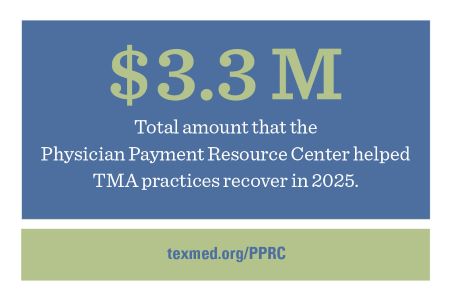
For more than 35 years, TMA’s PPRC – formerly known as the TMA Hassle Factor program until its name change in 2024 – has worked with public and private payers to alleviate Texas physicians’ administrative and payment issues. Its staff help to correct billing issues and represent physicians’ interests in regular meetings with Medicare, Medicaid, and major Texas health plans to resolve pressing payment concerns. In 2025, the program worked with Texas practices to help them recover more than $3.3 million.
TMA members can reach out to the resource center by submitting a payment review form via email or fax, calling the TMA Knowledge Center, or requesting assistance through the association’s website. Practices reaching out for assistance must have a business associate agreement on file with the association to comply with HIPAA.
Intake information is logged into the PPRC system. The resource center team then assesses each case and gathers additional information from physicians when needed, such as medical records, claim details, or interviews with the practice. Cases are elevated to the relevant payer if appropriate, or the practice receives education on coverage issues or billing and coding.
The program doesn’t just help resolve issues as they arise – it also works to prevent them. The PPRC staff also work to inform TMA’s payment policy positions and provide numerous educational materials, case studies, and guides on topics ranging from claims appeals, prior authorization, and coding best practices.
The PPRC “happily” fields questions from physician members at whatever stage of the administrative process they’re in, Ms. Benson said, from how to submit billing documentation to how to push back against a payer’s decision to deny a claim.
When PPRC staff and TMA physician leaders meet with payers, Ms. Benson builds a payer-specific agenda around distinct issues; legislative, regulatory, and market shifts; and TMA policy and research. These conversations let TMA communicate member concerns directly to health plan leaders, while the payers have an opportunity to offer feedback on trends in claim denials, miscoding, and other industry developments. Frequently, the payers also give TMA advance notice of upcoming payment policy changes so the association can share with members.
TMA also monitors how payers’ policy changes affect physician practices and the health care sector overall, drawing on input from members, patients, policymakers, legislators, and others. Research and member feedback are continually reviewed so staff are best positioned to help resolve physicians’ payment issues, Ms. Benson says.
“We do a lot more in the background than people think,” Ms. Benson said.
Alisa Pierce
Reporter, Division of Communications and Marketing
(512) 370-1469